Fly-in Safaris in Botswana
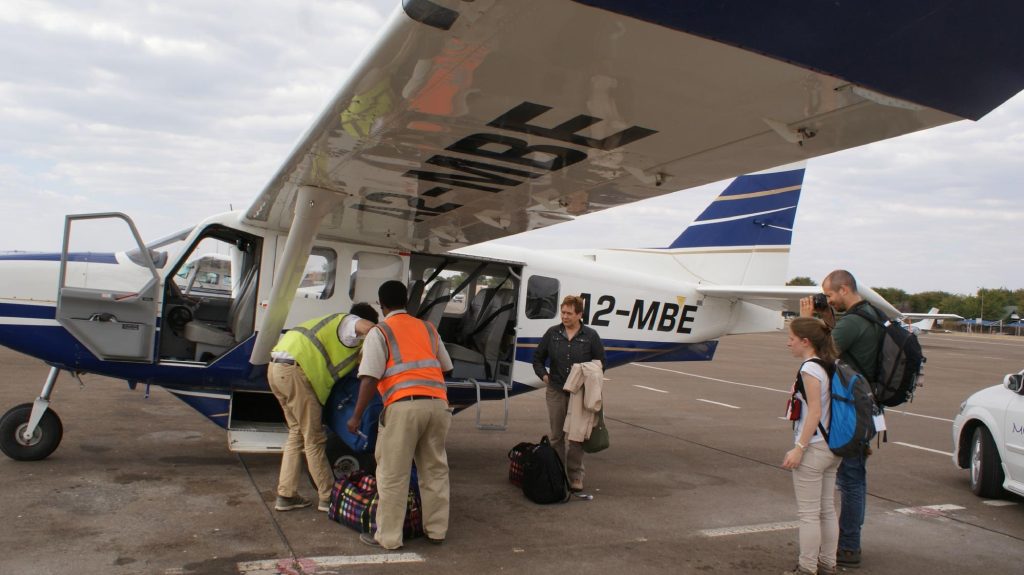
A fly-in safari moves you between camps by light aircraft rather than road, and in Botswana it is the standard rather than a luxury, because most of the best camps have no road access at all. In the Okavango Delta the airstrip is the front door. The single most important thing to know is the luggage limit: roughly 20kg per person in a soft bag with no frame, including hand luggage and camera gear.
Why Botswana Flies
This is not an upgrade so much as the only way in for much of the country.
Large parts of the Okavango Delta are surrounded by water with no road through, and camps on inner Delta islands are reachable by air and boat alone. The private concessions in Linyanti, Selinda and Kwando restrict road access deliberately, which is part of what keeps vehicle numbers low.
Distance is the other factor. Maun to Kasane is roughly 614 kilometres and close to seven hours by road via Nata, against an hour to an hour and a half in the air.
Flying also saves the parts of a trip nobody enjoys. A road transfer between two Delta camps could take most of a day; the same hop takes fifteen to thirty minutes.
And the flight itself is worth having. Low-level runs over the channels, islands and herds are among the better parts of a Botswana trip rather than dead time between them.
In the Okavango Delta the airstrip is the front door. Flying is not how you upgrade a Botswana safari, it is how most of the country is reached at all.
The Luggage Limit

Get this wrong and it becomes the defining problem of your trip, so it deserves the detail.
The standard allowance is 20kg per person total, including hand luggage and camera gear, though some operators set 15kg and a few as low as 10. Check your specific itinerary rather than assuming.
Bags must be entirely soft-sided, with no rigid frame and preferably no wheels, because they are loaded into small belly pods and need to squash. Hard suitcases are difficult or impossible to load and will most likely be left behind.
Dimensions matter as much as weight. Common limits run around 65cm long by 40cm wide by 30cm high, with some operators quoting smaller. A bag that exceeds the pod opening will not be loaded whatever it weighs.
Excess can usually be pre-booked as an additional luggage allowance or an extra seat, and an additional seat carries roughly 80kg. That must be arranged in advance rather than on the day.
Camps run same-day laundry as standard, frequently included, so you need far less than instinct suggests.
Passenger Weight
An awkward subject that operators raise for genuine safety reasons.
Charter companies calculate payload and fuel on the basis of passengers weighing around 100kg or less, with thresholds quoted variously between 90 and 115kg.
Passengers above that threshold must be declared in advance, because the aircraft cannot then carry its standard complement of passengers and baggage.
Where that applies, an additional seat is usually charged to compensate for the lost capacity.
This is not discretionary and it is not personal. A light aircraft taking off from a short bush strip in high afternoon temperatures has very little margin, and load calculations are what keeps it safe.
Declare it at booking. Discovering the issue at the airstrip is considerably worse than dealing with it months earlier.
What the Aircraft Are Like
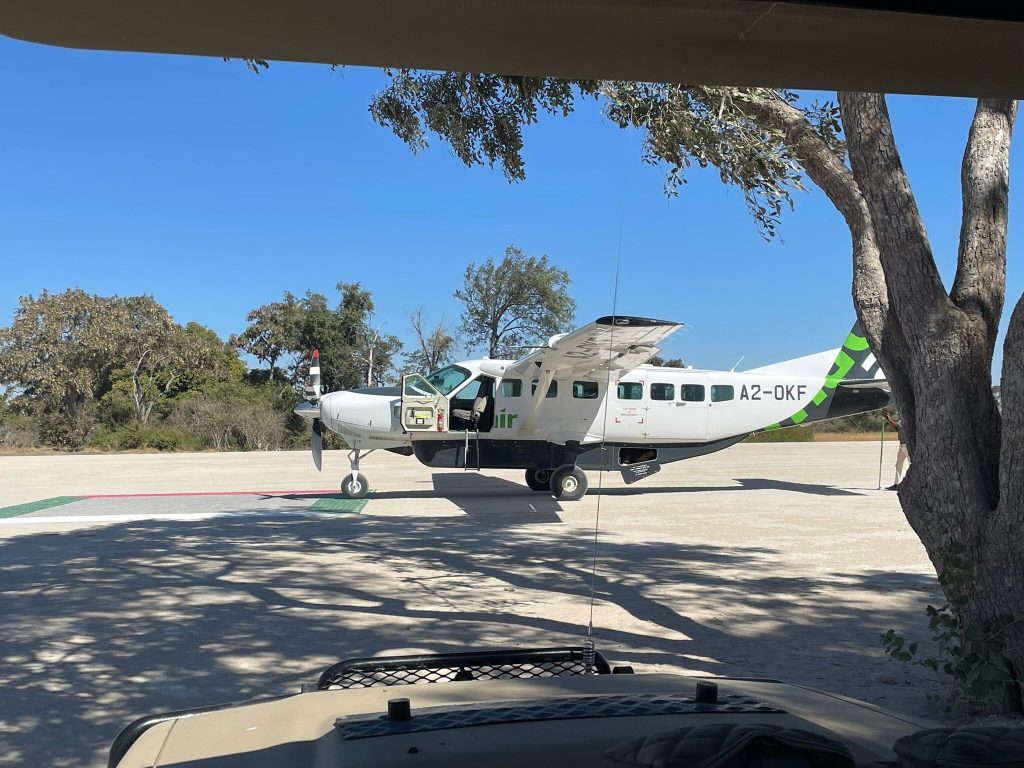
Small, and that surprises people.
Common types are the Cessna 206 and 210 carrying a pilot and around five passengers, the Airvan taking seven, and the Cessna Grand Caravan, which at twelve or thirteen passengers is as large as it gets.
Larger aircraft cannot use the short graded strips serving the parks and concessions, which is the constraint that shapes everything else.
Most transfers are shared seat-on-plane rather than private charter, so a flight may make several stops, dropping and collecting guests at other camps along the way. Lodges co-operate on daily schedules to keep costs down. A worked example flown end to end is the 4 day Okavango Delta safari.
Flights can be bumpy, particularly over the Delta in the middle of the day when thermals rise off the wetlands. This is normal, short-lived and not a sign of anything wrong.
Every seat is a window seat on these aircraft, and the views are the point.
Shared seat-on-plane. The standard. Scheduled transfers between camps with several stops, priced per seat and often bundled into camp rates. Cheapest and least flexible on timing.
Private charter. Your own aircraft with full flexibility on departure times and routing, and more generous luggage allowances depending on aircraft and party size. Considerably more expensive.
Helicopter. Used for scenic flights and some transfers, flown doors-off for photography. The same weight restrictions apply, and it reaches places fixed wing cannot.
How a Fly-in Day Works

The rhythm is consistent and worth knowing so you can plan around it.
You take a morning activity at your outgoing camp, then breakfast, then a short vehicle transfer to the airstrip, which is usually a graded strip a few minutes away.
There is often waiting. Aircraft run to a schedule built around other camps, and a strip in the middle of a concession has no terminal, just a windsock and sometimes a shade structure.
The flight lands at your next camp’s strip, where a vehicle meets the aircraft, and the drive to camp frequently becomes the first game drive.
Arrival is usually early to mid-afternoon, in time for tea and an afternoon activity.
A word on the airstrips themselves. They are strips of graded earth in the middle of a concession, unfenced and used by wildlife when no aircraft is present, so it is not unusual to arrive and find the vehicle waiting while a guide clears elephant or warthog off the runway. Guests stay in or beside the vehicle until the pilot signals, and the pilot has final say on everything from loading order to whether the flight goes at all.
One scheduling point matters more than any other: shared charters run to fixed afternoon cutoffs and bush strips close at dark, so a late international arrival into Maun costs you a night at camp that is rarely refundable. Land before mid-afternoon.
Planning a Fly-in Itinerary
A few principles keep the flying productive rather than exhausting.
Three nights per camp is the target. Each transfer costs roughly half a day once you count the activity you miss, the wait and the repacking, so two-night stays spend a disproportionate amount of your trip in transit.
Choose camps that are genuinely different from each other. Two Delta water camps do not justify a flight between them; a water camp and a land camp do.
Fly into one airport and out of another where routing allows, since backtracking wastes a day and multi-leg tickets are available.
Store excess luggage in Maun. Charter operators and hotels there offer free storage, frequently at no charge if your trip starts and ends in Maun.
Budget the charters separately. They run roughly 250 to 500 US dollars per person per leg where not bundled, and a four-camp itinerary needs three of them.
Build in slack at the end. A weather delay or a mechanical issue on a bush strip can push a transfer by hours, and a same-day connection onto an international departure leaves no room for that. An overnight in Maun or Kasane before flying home costs a fraction of a missed long-haul flight and removes the anxiety from the last two days of a trip.
Pack for the aircraft rather than the holiday. A 20kg soft duffel with no frame, including everything you carry on, is the constraint that decides what your trip looks like, and camps do same-day laundry so you need roughly half what you would take elsewhere.
Frequently Asked Questions About Fly-in Safaris in Botswana
What is the luggage limit on a Botswana fly-in safari?
Typically 20kg per person total including hand luggage and camera gear, though some operators set 15kg and a few as low as 10, so check your specific itinerary. Bags must be entirely soft-sided with no rigid frame and preferably no wheels, since they load into small belly pods and need to squash. Dimensions commonly cap around 65cm by 40cm by 30cm, and a bag exceeding the pod opening will not be loaded whatever it weighs.
How much do internal flights cost in Botswana?
Roughly 250 to 500 US dollars per person per leg where not bundled into camp rates, with some sources quoting scheduled seats around 300 and private charters from about 500. Private light aircraft charter has been quoted at roughly 1,200 to 3,500 US dollars per flight hour shared across a party. A four-camp itinerary needs three legs, so the flying is a substantial line item worth budgeting separately.
Why do light aircraft ask your weight?
Because payload and fuel are calculated on passenger weight, with charter companies working to a threshold around 100kg, quoted variously between 90 and 115. Passengers above that must be declared in advance, since the aircraft cannot then carry its standard complement of passengers and baggage, and an additional seat is usually charged. It is a safety calculation rather than a personal one, and declaring at booking avoids problems at the airstrip.
What aircraft do Botswana safaris use?
Cessna 206 and 210 carrying a pilot and around five passengers, Airvans taking seven, and the Cessna Grand Caravan at twelve or thirteen, which is as large as it gets. Larger aircraft cannot use the short graded strips serving the parks and concessions. Most transfers are shared seat-on-plane rather than private charter, so flights may make several stops dropping and collecting guests at other camps.
Are Botswana bush flights bumpy?
Sometimes, particularly over the Delta in the middle of the day when thermals rise off the wetlands and warm ground. This is completely normal, usually short-lived, and not a sign of anything wrong. Morning flights tend to be smoother than midday ones. The aircraft are small, every seat is a window seat, and the low-level views over channels, islands and herds are among the better parts of a Botswana trip.
Can I take a lot of camera equipment on a fly-in safari?
Only within the total allowance, since the limit includes camera gear rather than exempting it. Photographers travelling with large lenses and tripods frequently need to pre-book an extra seat, which carries roughly 80kg of additional capacity. That must be arranged in advance rather than on the day, and excess presented at the airstrip without pre-booking is carried entirely at the captain’s discretion or left for a later flight.
Booking Your Botswana Trip
The safari companies and tour operators listed on this website put trips like this together for a living and know which camps, guides and routes actually deliver. We are an independent guide to Botswana; we do not book or sell tours ourselves.
When you are ready, arrange your safari, tour or holiday with one of the recognised operators listed here. Tell them your dates and what matters most, and a real person, not a form, will handle the itinerary, park bookings and logistics for you.