Botswana Airports Guide

Botswana has four airports handling scheduled passenger flights: Sir Seretse Khama International in Gaborone, Maun International, Kasane International and Francistown. Maun and Kasane are the two that matter for a safari, serving the Okavango Delta and Chobe respectively, while Gaborone carries the majority of international arrivals and Francistown handles domestic flights only. Botswana also has dozens of bush airstrips serving remote camps, reachable only by light aircraft charter.
Maun International Airport for Okavango Delta Safaris
Maun, coded MUB, is the airport most safari visitors will use and the one that behaves least like an ordinary airport.
It sits around two to five kilometres from the town centre, close enough that the transfer to a Maun hotel takes minutes. The terminal is small and the atmosphere is closer to a regional airfield than an international gateway, which suits what happens there.
What makes Maun unusual is traffic volume of a very particular kind. By aircraft movements it ranks among the busiest airports in southern Africa, and almost all of that is light aircraft ferrying guests out to Delta camps. Walk through the terminal in the middle of a peak season day and the apron is a queue of Cessna Caravans loading soft duffel bags.
Scheduled services connect Maun with Johannesburg and Cape Town on Airlink, and with Gaborone and Kasane on Air Botswana. Ethiopian Airlines has connected Maun with Addis Ababa, which is the one route offering a long-haul path that avoids South Africa.
The airport has been modernised in recent years with terminal upgrades, and facilities cover the basics rather than the luxurious: a café, curio shops, car hire desks and the charter operators’ offices.
Kasane International Airport for Chobe Safaris
Kasane, coded BBK, serves the Chobe region and has changed considerably following a substantial expansion, gaining a new terminal building of around 7,800 square metres, an extended runway able to take larger aircraft, and improved ground handling.
Its position is the selling point. Sedudu Gate into Chobe National Park is minutes away by road, meaning you can land and be on a game drive the same morning without any internal flight. Most riverfront lodges are within a 45-minute drive, and many are far closer.
Victoria Falls sits around 80 kilometres away by road, which makes Kasane the practical crossing point for anyone combining Botswana with Zimbabwe or Zambia. Mack Air runs a scheduled service between Kasane and Victoria Falls taking roughly twenty minutes, bypassing the Kazungula border queue entirely.
Scheduled flights link Kasane with Johannesburg on Airlink and with Gaborone and Maun on Air Botswana. The terminal offers duty free, curio shops selling Botswana handicrafts, a small cafeteria and air conditioning throughout.
Kasane is also the launch point for the Kavango-Zambezi Transfrontier Conservation Area, the five-country protected zone spanning Angola, Botswana, Namibia, Zambia and Zimbabwe.
Kasane is the only major Botswana safari destination reachable without an internal charter flight. For a short trip, a tight budget, or anyone nervous about small aircraft, flying into Kasane and staying on the Chobe riverfront removes the light aircraft leg entirely.
Sir Seretse Khama International Airport in Gaborone
Gaborone, coded GBE, is the country’s principal airport by scheduled flight numbers, handling the majority of international arrivals from within Africa and serving as Air Botswana’s main operating base.
It is the capital’s airport and functions accordingly, oriented toward business, government and regional connectivity rather than tourism. Routes link it with Johannesburg, Cape Town, Harare, Lusaka and Addis Ababa.
For a safari visitor, Gaborone is usually the wrong airport. It sits a very long way from the northern parks, roughly a thousand kilometres from Maun, and reaching the Delta from here means a domestic flight anyway. The exceptions are travellers heading for the Tuli Block, the southern Kalahari or Khutse, and anyone combining a safari with business in the capital.
Facilities are the fullest in the country, with banks, ATMs, foreign exchange desks, car hire and the usual airport services.
Francistown Airport and Regional Airfields

Francistown, coded FRW, is Botswana’s second city and its airport is the only one of the four to handle domestic flights exclusively, with no international services at all. Air Botswana links it to Gaborone.
It serves the northeast of the country and functions for business travel and regional connectivity rather than tourism. Very few safari itineraries touch it.
Beyond the four scheduled airports lies the network that actually delivers Botswana’s safari traffic: dozens of unpaved bush airstrips scattered across the Delta, Chobe, Linyanti, the Kalahari and the pans. Many camps have their own private strip, and others share one serving several properties.
These strips are gravel or compacted sand, unlit, and closed after dark, which is why night medical evacuations are difficult. Arrivals are met by a camp vehicle at the strip, and there is nothing there beyond a windsock and occasionally a shade structure. Elephants and warthogs on the runway are a routine reason for a pilot to circle and come round again.
Maun (MUB). Gateway to the Okavango Delta, Moremi and the Kalahari. Hub for light aircraft charters. Johannesburg, Cape Town, Gaborone, Kasane and Addis Ababa connections. Two to five kilometres from town.
Kasane (BBK). Gateway to Chobe, Linyanti and Savuti. Minutes from Sedudu Gate, around 80km from Victoria Falls. Recently expanded terminal and runway. Johannesburg, Gaborone and Maun connections.
Gaborone (GBE). Capital airport and Air Botswana base, busiest by scheduled flights. Serves business, the Tuli Block and the south. Roughly a thousand kilometres from Maun.
Francistown (FRW). Domestic only, linking to Gaborone. Serves the northeast for business rather than safari travel.
What to Expect at Botswana Airport Arrivals
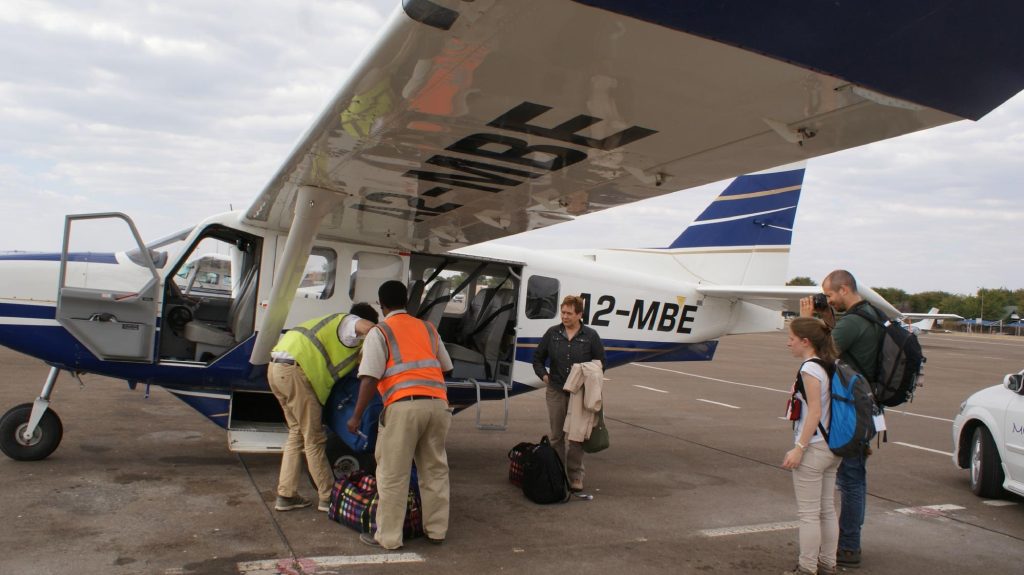
Arrival formalities are straightforward and quick at Maun and Kasane, both of which are small enough that you are through in minutes when a single flight has landed.
You present your passport, receive a stamp recording the days granted, and pay the Tourism Development Levy that applies to all international visitors. Card terminals are not always working, so have some cash available. Customs is usually a walk-through.
Charter operators and lodge representatives meet arrivals in the terminal, typically holding a sign with your name or your camp’s, and they will walk you across to the charter terminal or the vehicle. This handover is normally arranged by your operator in advance and works smoothly.
Gaborone takes longer, being a larger operation, though it is not a difficult airport by any measure.
Departure works the same way in reverse and is worth planning for. Camps put you on a morning charter timed to meet the afternoon international departure, so you will often leave camp before breakfast has properly finished. Check-in at Maun and Kasane is quick, though the international departure hall at Maun is small and fills up when two flights leave together, so arriving early buys you a seat rather than a wall to lean on.
Baggage storage is available at both Maun and Kasane for luggage exceeding the charter weight limit, which is worth knowing if you are arriving from a longer trip with more than a duffel.
Airport Facilities and Practical Details
ATMs exist at Gaborone and in Maun, including one across the road from the airport, and Kasane has banking facilities in town. Withdraw Pula before flying out to camp, since there are no machines in the Delta or the Kalahari.
SIM card kiosks operate at Gaborone and Maun in the arrivals area, though hours are limited and a late or Sunday arrival can find them closed. An eSIM installed before departure avoids the problem.
Car hire desks operate at all the main airports for self-drive travellers, and vehicles should be booked well ahead in peak season.
Food and shopping are limited everywhere except Gaborone. Eat before you fly rather than counting on the terminal, particularly if a charter connection means several hours in transit.
Frequently Asked Questions About Botswana Airports
How many airports does Botswana have?
Four handle scheduled passenger flights: Sir Seretse Khama International in Gaborone, Maun International, Kasane International and Francistown. Gaborone and Maun together account for more than 85 percent of departing flights. Francistown is the only one restricted to domestic services. Beyond these, dozens of unpaved bush airstrips serve remote camps across the Delta, Chobe, Linyanti and the Kalahari, reachable only by light aircraft charter.
Which is the main airport in Botswana?
Sir Seretse Khama International in Gaborone is the busiest by scheduled flight numbers and the main base for Air Botswana, handling the majority of international arrivals from within Africa. For safari travellers, though, Maun is the more relevant hub, ranking among the busiest airports in southern Africa by aircraft movements because of the volume of light aircraft carrying guests to Okavango Delta camps.
How far is Maun Airport from the Okavango Delta?
The airport sits on the southern edge of the Delta, two to five kilometres from Maun town, but Delta camps are reached by air rather than road. Charter flights from Maun to camp airstrips typically take 15 to 45 minutes, with many hops around 20 minutes and crossings from one side of the Delta to the other closer to 30. A flight to Mombo on Chief’s Island, for example, runs about 25 minutes.
Can I get from Kasane Airport to Chobe National Park directly?
Yes, and this is what makes Kasane unusually convenient. Sedudu Gate into Chobe is minutes away by road, so you can land and be on a game drive the same morning with no internal flight required. Most riverfront lodges are within a 45-minute drive and many are considerably closer. Kasane is the only major Botswana safari destination reachable without a light aircraft charter.
What are the bush airstrips in Botswana like?
Basic by design. They are gravel or compacted sand, unlit, closed after dark, and typically have nothing beyond a windsock and sometimes a shade structure. A camp vehicle meets each arrival. Many camps have their own strip and others share one serving several properties. Wildlife on the runway is routine, and a low pass to clear elephants or warthogs before landing is normal rather than alarming. The lack of lighting is why night medical evacuations are difficult.
Is there luggage storage at Botswana airports?
Yes, at both Maun and Kasane, which matters because charter flights limit you to roughly 20kg in a soft bag including hand luggage and camera gear. Excess luggage can be left in storage until you return, or you can pre-book an additional charter seat to carry it, which allows a substantially larger allowance at extra cost. Arrange either at booking rather than at the desk on the day.
Booking Your Botswana Trip
The safari companies and tour operators listed on this website put trips like this together for a living and know which camps, guides and routes actually deliver. We are an independent guide to Botswana; we do not book or sell tours ourselves.
When you are ready, arrange your safari, tour or holiday with one of the recognised operators listed here. Tell them your dates and what matters most, and a real person, not a form, will handle the itinerary, park bookings and logistics for you.