Campsites in Botswana
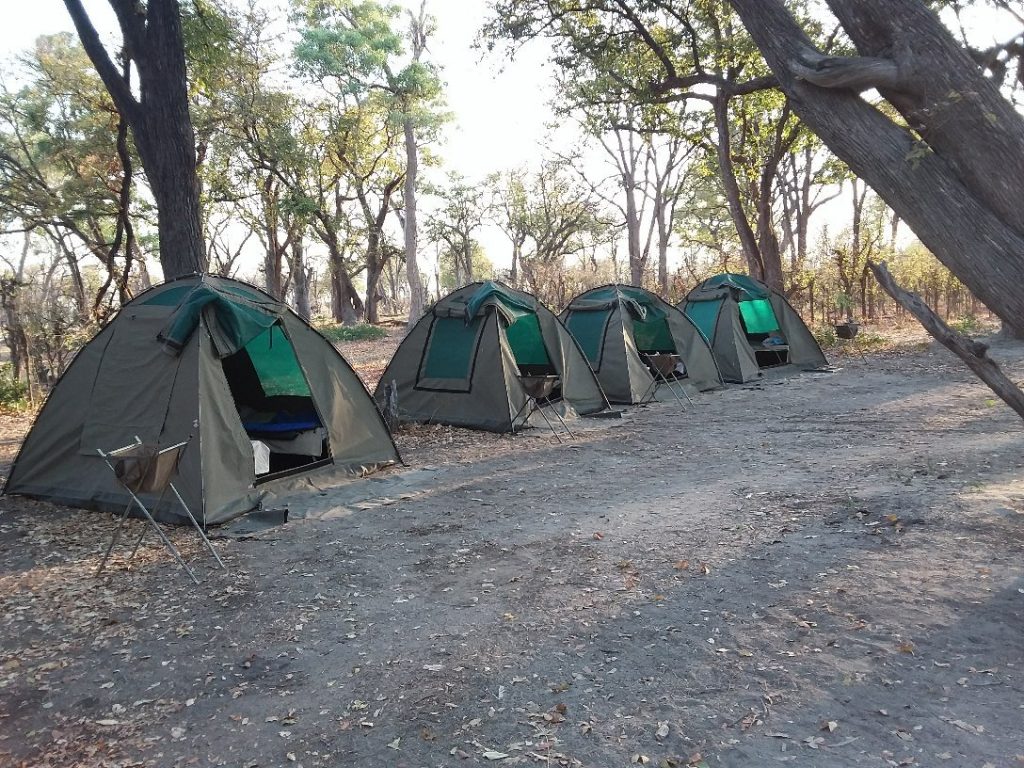
Campsites inside Botswana’s national parks must be booked well in advance, and the booking process is genuinely awkward because most sites were transferred from the Department of Wildlife and National Parks to a patchwork of private operators, each taking reservations separately. Sites are unfenced, wildlife walks through them, and you must be fully self-sufficient. Botswana is a southern African safari country where camping is the only affordable way to sleep inside Moremi, Chobe and the Central Kalahari.
How Camping Works Inside Botswana’s National Parks
Camping is not a fallback option here. It is the only way to stay overnight inside the national parks without paying lodge rates, and for self-drive travellers it is the whole trip.
All camping is at designated sites, booked ahead. Wild camping is not permitted inside the parks and reserves, and you will be moved on or fined.
Sites are unfenced. Elephants walk through, hyenas visit at night, and lions pass by. This is normal, the safety record is reasonable, and the rules are simple: sleep inside your tent, keep food sealed and inside a vehicle, do not leave anything scented outside, and use a torch when moving around after dark.
You need to be fully self-sufficient on water, food, fuel and recovery equipment. There is no shop, no fuel and no help.
The Botswana Campsite Booking Problem
This is the part that catches out nearly every first-time self-driver, and it deserves explaining properly because no amount of good intentions substitutes for knowing how it works.
Botswana’s public campsites used to be run entirely by the Department of Wildlife and National Parks. Over the years most were handed to private operators, and the result is a patchwork with no logic to it. Different companies hold different sites within the same reserve, and a few remain with the department.
In Moremi, for example, one operator holds Third Bridge while another holds Xakanaxa and South Gate and a third holds North Gate at Khwai. Chobe splits similarly between Ihaha on the riverfront and Savuti and Linyanti inland. The Central Kalahari and Khutse sites sit with another operator again.
Each takes bookings separately, by phone or email rather than a website, and payment methods vary. There is no single national booking system.
Double bookings happen. Travellers have arrived at a reserved site to find another party already there with a booking made through a different channel.
Check availability at every site on your route before paying for any of them, and hold provisional bookings across the whole itinerary before committing. Paying for one leg and then finding the next is full is how self-drive plans collapse.
Booking Campsites and Paying Park Fees in Order
There is a sequence to this and doing it in the wrong order costs you time.
Park entry fees are paid to the Department separately from camping fees, and the Department will only take park fees once all camping fees have been settled, whether the sites are theirs or a private operator’s.
The workable method is to check Department-run sites first and hold provisional reservations. Then contact the private operators and check their availability for the same dates. If everything lines up, pay the private operators, collect their booking vouchers, then return to the Department, submit the vouchers and pay for their camping plus your park fees together.
If you are camping only at privately run sites, book those first and send the vouchers to the Department. If you are only at Department sites, camping and park fees can be settled in one transaction.
Park entry has been refused at the gate for incorrect paperwork, so arrive with everything in order rather than expecting to sort it there.
Plenty of travellers hand the whole thing to a Maun-based operator who consolidates campsites, permits and vehicle in one booking. For a first Botswana self-drive that is money well spent.
The Best Campsites in Moremi and Chobe
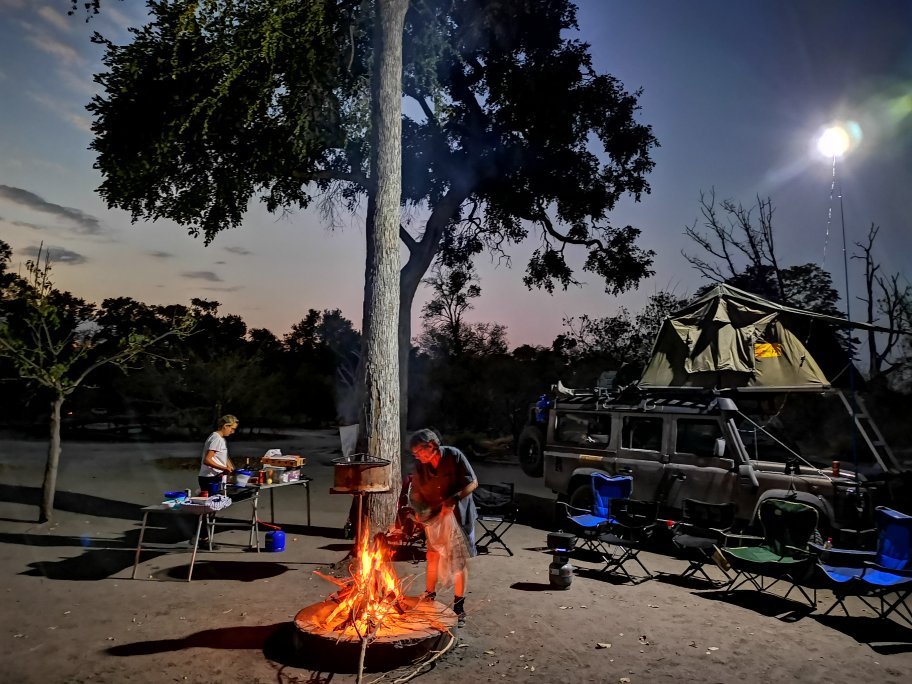
Not all sites are equal, and a few are worth planning a route around.
In Moremi, Third Bridge and Xakanaxa sit at the end of the Moremi Tongue and are consistently rated the best in the reserve. They feel the wildest, have the most wildlife moving through, and put you close to the productive game drive tracks. North Gate at Khwai is excellent too, particularly the sites right by the river’s edge. South Gate is the least wild and furthest from the good game areas.
In Chobe there are only three campsites, one in each area: Ihaha on the riverfront, Savuti and Linyanti. By default these are the best available, and Savuti in particular has good facilities and is well kept.
In the Khwai community area outside the reserve, Magotho, Khwai Safari Grounds and Mbudi all work well. At Magotho, ask for a riverside site rather than accepting whatever you are given.
All of these are popular and book out far ahead, though last-minute cancellations do occur and trying your luck at the gate occasionally works.
Facilities at Botswana Campsites
Standards vary sharply between the main park sites and the remote desert ones, and knowing which you are heading for changes what you pack.
The main sites in Moremi, Chobe and Khwai have shared ablution blocks with flush toilets and hot showers, and facilities have improved considerably over the years. There is no electricity anywhere.
Remote sites in the Central Kalahari, Khutse and parts of Makgadikgadi are a different proposition. These are standalone pitches, often with nothing but a drop toilet, a bucket shower frame and a fire pit. You bring your own water. Some have no water at all.
Firewood is available in some areas and absent in others, so ask when booking rather than assuming.
Nothing takes cards, nothing has a shop, and mobile signal at most sites is non-existent.
Main park campsites. Moremi, Chobe and Khwai. Shared ablutions with flush toilets and hot showers. Popular, book far ahead. Unfenced with regular wildlife movement through camp.
Remote desert campsites. Central Kalahari, Khutse, parts of Makgadikgadi. Standalone pitches, drop toilet and bucket shower frame at best, bring all your own water. Total self-sufficiency required.
Community and private campsites. Khwai community area and sites outside park boundaries. Variable facilities, often good value, sometimes with night drives permitted since they sit outside the parks.
What You Need to Camp in Botswana
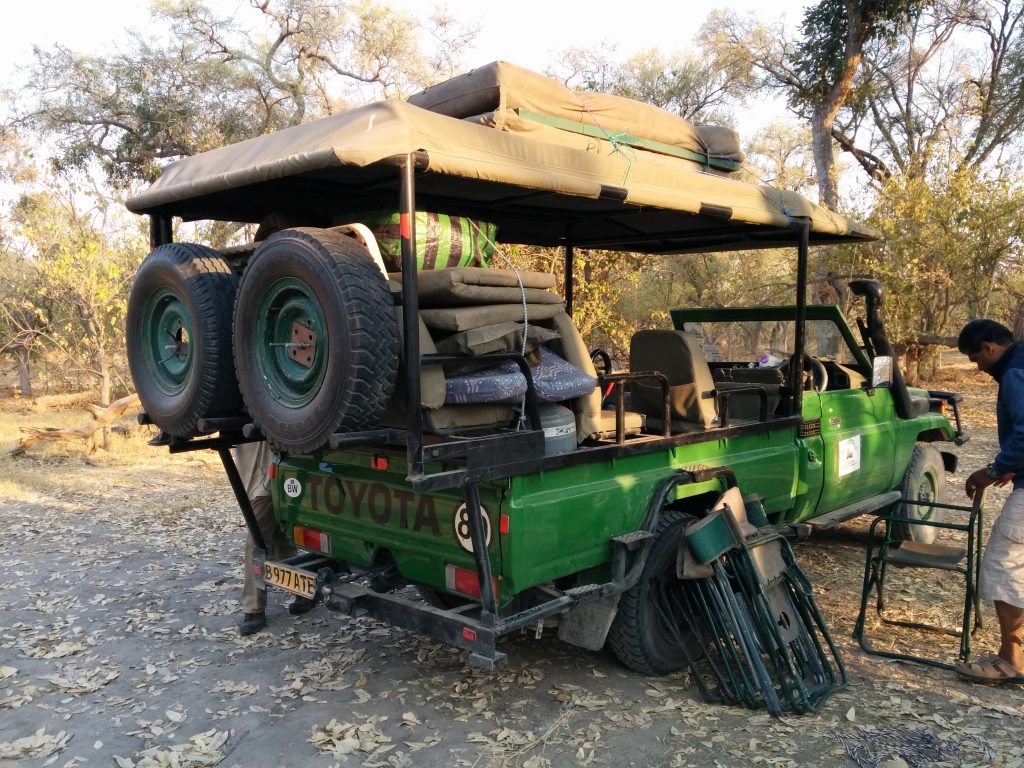
A properly equipped 4×4 is the starting point rather than a preference. Moremi, Chobe and the Central Kalahari are deep sand and a two-wheel drive will bog down within metres.
Rental vehicles from the established Maun and Kasane operators come fitted for this: rooftop tent, dual battery with fridge, gas and cooking kit, water tank commonly around 45 litres, jerry cans for extra fuel, and recovery gear.
Check the recovery kit item by item. A shovel, a tow rope, a compressor for reinflating tyres after sand driving and two inflated spares are what stand between a stuck vehicle and a very long wait.
Carry more water than the tank holds if you are heading into the Kalahari. Carry firewood where it is not available. Carry cash, since nothing at a campsite takes cards.
Book your route so each day’s drive finishes well before dark, because arriving at an unfamiliar site at night in an unfenced reserve is a bad combination.
Camping Safety in Unfenced Botswana Campsites

The rules are few and they work if followed without exception.
Stay in your tent at night. Whatever you hear outside, and you will hear a great deal, going out to look is the mistake. Use the vehicle if you need to move.
Keep all food sealed and inside the vehicle rather than in the tent or on the table. Hyenas will investigate a camp thoroughly, and they are strong enough to take a cool box. Toiletries count as food to a hyena, so soap and toothpaste go inside too.
Never feed anything, including the birds and monkeys that arrive at breakfast, since habituated animals become dangerous animals.
Watch for elephants on paths between your pitch and the ablution block, and give them room rather than trying to slip past.
Baboons and vervet monkeys will open an unattended vehicle door and empty a cool box in minutes.
Frequently Asked Questions About Camping in Botswana
How much do campsites cost in Botswana?
Rates vary by operator rather than being nationally set. Department of Wildlife camping for non-residents has been listed at 30 Pula per person per night, with wilderness sites at 200 Pula. Privately run sites charge considerably more, with figures reported around 185 to 210 Pula per person at some park sites, 300 Pula at Third Bridge and 400 at Gcodikwe, and around 168 Pula for Central Kalahari and Khutse sites. Park entry is separate at 120 Pula per person per day for non-residents. Children under eight are usually free.
How do I book campsites in Botswana’s national parks?
Contact each operator directly by phone or email, since there is no single national booking system and different companies hold different sites within the same reserve. Check availability across your whole route before paying for anything. Park fees are settled with the Department only after all camping fees are paid, so the usual sequence is: hold Department sites provisionally, book and pay private operators, collect their vouchers, then return to the Department to pay camping and park fees together.
Which are the best campsites in Moremi Game Reserve?
Third Bridge and Xakanaxa, both at the end of the Moremi Tongue, are consistently rated highest. They feel the wildest, attract the most wildlife moving through camp and sit close to the productive game drive tracks. North Gate at Khwai is also excellent, particularly the sites right on the river’s edge. South Gate feels the least wild and is furthest from the areas of high game concentration. All book out well ahead in dry season.
Are Botswana campsites fenced?
No. Sites inside the national parks and reserves are unfenced, and elephants, hyenas and occasionally lions move through them. The safety record is reasonable because the rules are straightforward: stay in your tent at night whatever you hear, keep all food and toiletries sealed inside your vehicle rather than in the tent, never feed anything, and use a torch when moving around. Give elephants on the path to the ablution block plenty of room.
What facilities do Botswana campsites have?
It depends entirely which you book. Main sites in Moremi, Chobe and Khwai have shared ablution blocks with flush toilets and hot showers, and facilities have improved over the years. Remote sites in the Central Kalahari, Khutse and parts of Makgadikgadi are standalone pitches with at best a drop toilet, a bucket shower frame and a fire pit, and you bring all your own water. There is no electricity anywhere and no shops.
Can I turn up at a Botswana campsite without a booking?
It is not the plan to rely on, though it occasionally works. Sites must be reserved in advance and park entry has been refused at the gate for paperwork errors. Popular sites including Third Bridge, Xakanaxa, Ihaha, Savuti and Linyanti book out far ahead in dry season. Last-minute cancellations do happen, so trying your luck at a gate is worth a shot if a plan changes, but arriving hundreds of kilometres from anywhere hoping for a space is not sensible.
Booking Your Botswana Trip
The safari companies and tour operators listed on this website put trips like this together for a living and know which camps, guides and routes actually deliver. We are an independent guide to Botswana; we do not book or sell tours ourselves.
When you are ready, arrange your safari, tour or holiday with one of the recognised operators listed here. Tell them your dates and what matters most, and a real person, not a form, will handle the itinerary, park bookings and logistics for you.