Hyenas in Botswana
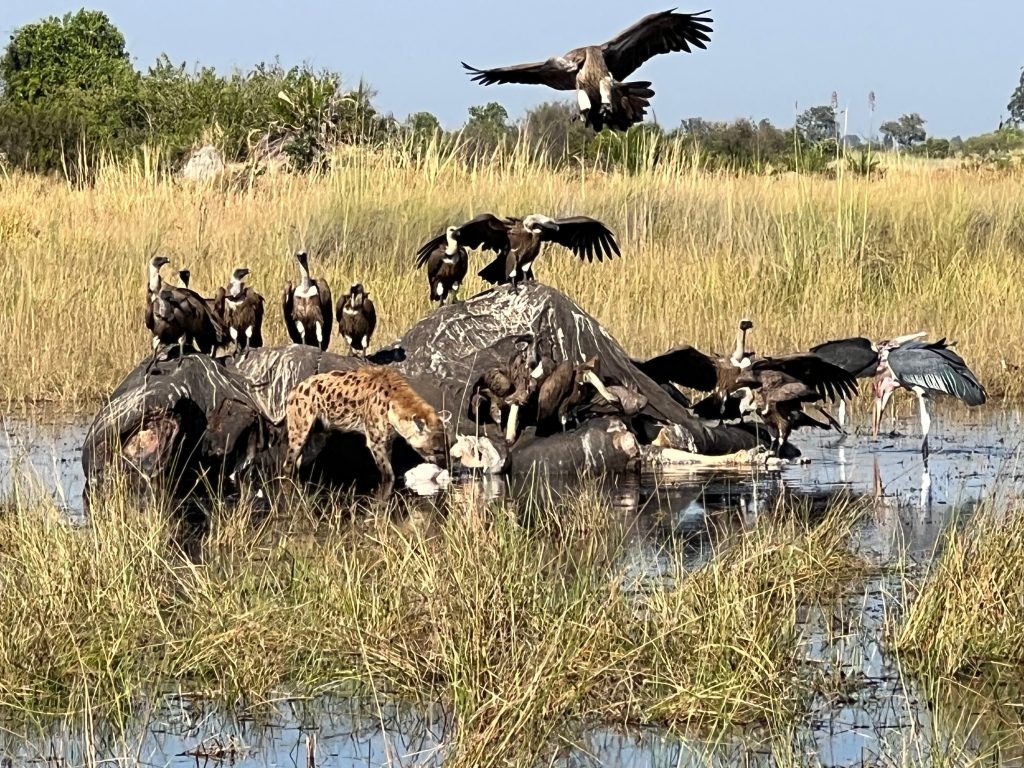
Botswana holds two hyena species: the spotted hyena, common and highly successful across the north, and the brown hyena, shy, rarely seen and largely confined to the Kalahari. Both are far better hunters than their reputation allows, with spotted hyenas killing most of their own food rather than scavenging. Savuti and the Linyanti hold thriving spotted hyena populations, while the Central Kalahari and the Kgalagadi are the places for brown.
Two Species, Two Different Animals
Confusing the two is easy and the differences run deeper than appearance.
The spotted hyena is the larger and by far the more numerous, the most widespread predator in Africa, found in almost every country south of the Sahara. It occupies everything from Kalahari desert to Okavango wetland.
The brown hyena is slightly smaller, with pointed wolf-like ears, a long shaggy dark brown coat, striped brown and white legs and a cream mane around the neck. It exists only in southern Africa and is far harder to see, being both restricted in range and genuinely retiring.
Behaviour separates them decisively. Spotted hyenas are social hunters living in large clans. Brown hyenas are predominantly scavengers, usually seen alone, though they do live in extended family clans that cooperate to raise cubs.
When irritated, a brown hyena raises the hair along its neck and back, which makes it look considerably larger and is used to drive other predators, even leopards, off a kill.
Spotted hyenas get between 70 and 80 percent of their food from their own kills in Botswana’s parks. The scavenger reputation is close to backwards, and lions steal from hyenas at least as often as the reverse.
Spotted Hyenas as Hunters
This is where the popular picture is most wrong and it is worth correcting properly.
Spotted hyenas are among the most common and successful predators a visitor will see, and in Botswana’s Central Kalahari and Chobe they kill something like 70 to 80 percent of their own prey.
They hunt differently from cats. Rather than stalking, they rely on speed and stamina, running prey down over distance. They sprint at around 60 kilometres per hour and can hold 40 to 50 over five kilometres, which almost nothing can outlast.
The kill is not clean. They bite chunks from prey as it runs, targeting major blood vessels, which is unpleasant to watch and efficient.
Clans feed mainly on resident game such as impala and warthog, and take newborns from the migrating herds when the zebra pass through.
Their digestive system is legendary and their jaws crush bone easily. They eat bone and vegetation, and have been known to take campers’ supplies including the tin.
Clan Society
Hyena social structure is genuinely unusual and it is the thing guides most enjoy explaining.
Clans are matriarchal, led by a dominant female, with all males and other females subordinate to the female members. Clans reach up to 80 animals.
The stable core is the dominant female and successive generations of her daughters and their offspring. Resident males and immigrant males make up the rest.
Immigrant males have a hard time of it. They are accepted only after weeks of cautious approaches and subordination, bearing the brunt of clan aggression throughout.
Rank is inherited. Female cubs take their mother’s rank and fight furiously to hold it, and the matriarch’s cubs automatically outrank everyone else’s.
Cubs are born at any time of year, usually two at a time, with most births in the wet season when prey is calving. During pregnancy the mother produces additional androgen, which makes the cub larger and more aggressive, and the dominant female’s daughter usually becomes her successor.
Where to See Spotted Hyenas
They are widespread across northern Botswana and reliably seen with a little planning.
Savuti is the standout, with unusually high numbers and a long-documented rivalry with the local lion prides. The two species compete directly over scarce food and the conflict has been filmed extensively.
The Linyanti holds thriving populations alongside lion as the principal predators.
Khwai is the reliable option for seeing them properly, since it permits night drives that Moremi does not, and hyenas are most active after dark.
Moremi and the Okavango hold them throughout, with several hundred thought to occupy the Delta though no firm count exists.
Chobe and the Mababe both have good numbers.
Early morning drives catch them returning from a night’s work, often at a kill.
Spotted hyena. Common across northern Botswana, especially Savuti, Linyanti, Khwai and Moremi. Social, matriarchal clans up to 80 strong, hunting most of their own food. Best seen on night drives.
Brown hyena. Restricted to the Kalahari, principally the Central Kalahari and the Kgalagadi. Shy, largely nocturnal, usually seen alone. Deception Valley and the Makgadikgadi edges are the productive areas.
Where to base yourself. Khwai or a Linyanti concession for spotted hyena on night drives, and a Central Kalahari or Makgadikgadi camp for a realistic chance of brown.
Finding Brown Hyenas
This is the harder proposition and one of the genuine prizes of a Kalahari trip.
Brown hyenas are most numerous in the Central Kalahari Game Reserve and the Kgalagadi Transfrontier Park, with the Kgalagadi holding what is described as the largest protected brown hyena population anywhere, with surveys suggesting up to 2,000 individuals across the park.
Deception Valley in the Central Kalahari, made famous by the research behind Cry of the Kalahari, has a good population. The Makgadikgadi Pans are the other productive area, particularly around the pan edges.
They are mainly crepuscular and nocturnal, lying up during the day in cover or in abandoned burrows, which makes night drives the best opportunity.
Clan territories can cover up to 500 square kilometres, and individuals travel up to 35 kilometres in a single night foraging, so they are spread very thin.
Camps with habituated clans nearby give the best odds, and one camp in the north holds the most northerly recorded den site with a habituated clan.
The Reputation Problem
Hyenas carry more cultural baggage than any other African predator and it is worth addressing.
They have been viewed with revulsion for a very long time, appearing across African folklore as symbols of anything from wisdom to immorality, and modern film has cemented an image of cowardice that does not match the animal.
In reality they are highly intelligent with a complex hierarchical society, and they kill most of what they eat.
The relationship with lions is genuine competition rather than a pecking order. Lions kill hyenas where they can, hyenas mob lions in numbers, and each steals from the other. Savuti is where that has been most closely watched.
Guides who take the time to explain clan structure and how much they actually kill usually convert a vehicle full of sceptics within one sighting.
The whooping call carrying across a night at camp is among the defining sounds of an African safari, and once you know what it is, it stops being sinister.
There is a conservation angle too. Hyenas take livestock on the margins of protected areas and are killed in retaliation, which is the same pressure facing lion, cheetah and wild dog across the Kalahari boundaries. Because they are widely disliked, they attract far less conservation funding and public sympathy than the cats, while performing much the same ecological role and, in Botswana at least, killing much the same proportion of their own food.
Book at least one night drive if hyenas interest you. Both species are largely nocturnal, and a spotlit drive on a concession or at Khwai shows a hyena working rather than sleeping, which is a completely different animal from the one dozing under a bush at midday.
Frequently Asked Questions About Hyenas in Botswana
What hyena species live in Botswana?
Two. The spotted hyena is common across the north and is the most widespread predator in Africa, occupying everything from Kalahari desert to Okavango wetland. The brown hyena is smaller, with pointed wolf-like ears, a shaggy dark coat, striped legs and a cream neck mane, exists only in southern Africa and is largely confined to the Kalahari. Spotted hyenas are social hunters in large clans; brown hyenas are mainly scavengers usually seen alone.
Do hyenas really only scavenge?
No, and the reputation is close to backwards for spotted hyenas. In Botswana’s Central Kalahari and Chobe they kill something like 70 to 80 percent of their own prey, relying on speed and stamina rather than stalking. They sprint at around 60 kilometres per hour and hold 40 to 50 over five kilometres. Lions steal from hyenas at least as often as the reverse. Brown hyenas are genuinely more scavenger than hunter.
Where can you see brown hyenas in Botswana?
The Central Kalahari Game Reserve and the Kgalagadi Transfrontier Park, which holds what is described as the largest protected brown hyena population anywhere with surveys suggesting up to 2,000 individuals. Deception Valley and the Makgadikgadi pan edges are productive. They are crepuscular and nocturnal, lying up by day, so night drives give the best chance. Territories run up to 500 square kilometres and individuals cover up to 35 kilometres a night.
Are hyena clans led by females?
Yes, and rigidly so. Clans are matriarchal, led by a dominant female with all males and other females subordinate to the female members, reaching up to 80 animals. The stable core is the dominant female and successive generations of her daughters. Rank is inherited, with female cubs taking their mother’s rank and the matriarch’s cubs automatically outranking others. Immigrant males are accepted only after weeks of subordination and clan aggression.
Where is the best place to see spotted hyenas?
Savuti is the standout, with unusually high numbers and a long-documented rivalry with the local lion prides over scarce food. The Linyanti holds thriving populations, and Khwai is the practical choice because it permits night drives that Moremi does not, and hyenas are most active after dark. Moremi and the wider Okavango hold several hundred, and Chobe and the Mababe both have good numbers.
Are hyenas dangerous to visitors?
They are opportunistic around camps rather than aggressive toward people. Their jaws crush bone easily and they have been known to take campers’ supplies, including tins, which is why food should never be left out and tents should be zipped closed. Camps are unfenced and hyenas walk through them at night, so use the staff escort between tent and dining area rather than walking alone after dark.
Booking Your Botswana Trip
The safari companies and tour operators listed on this website put trips like this together for a living and know which camps, guides and routes actually deliver. We are an independent guide to Botswana; we do not book or sell tours ourselves.
When you are ready, arrange your safari, tour or holiday with one of the recognised operators listed here. Tell them your dates and what matters most, and a real person, not a form, will handle the itinerary, park bookings and logistics for you.