Cheetahs in Botswana

Botswana holds one of the world’s largest cheetah populations, estimated at around 1,700 animals, which is roughly a quarter to a third of all wild cheetahs remaining. Most of them live outside the protected areas on farmland, where they come into conflict with livestock owners. The best viewing is on the open plains of the Central Kalahari, Makgadikgadi and Nxai Pan rather than in the wildlife-dense north.
How Many Cheetahs Are There
The numbers here are worth setting out because they explain why Botswana matters so much for the species.
Botswana’s population is estimated at approximately 1,700 individuals. Against a global wild population of somewhere around 7,000 to 7,100, that is roughly 25 to 30 percent of every wild cheetah left on earth.
Botswana and neighbouring Namibia together hold almost half the world total.
The context is grim. Cheetah is Africa’s most threatened large cat, with the global population having declined by around 90 percent over the past century and human encroachment costing roughly 75 percent of the range they once occupied.
Botswana’s position in the centre of southern Africa also makes this population critical for connectivity, linking the remaining groups in Namibia, South Africa, Zimbabwe, Zambia and Angola.
More than 70 percent of Botswana’s cheetahs live outside protected areas, on farmland. That single fact shapes everything about cheetah conservation here and explains why the work happens with farmers rather than in parks.
Why Cheetahs Live Outside the Parks
This is counterintuitive and the explanation is ecological rather than administrative.
Cheetahs are outcompeted inside formally protected areas, which hold higher densities of larger competing carnivores. Lions and hyenas kill cheetahs and steal their kills, and a cheetah cannot defend either.
The result is that agricultural farmland functions as critical cheetah habitat in Botswana, since it holds prey without the predator competition. Figures of over 70 percent, and in some accounts 78 percent, living outside reserves are commonly cited.
That puts them among livestock, which is where the trouble starts. Human-wildlife conflict is the greatest threat to Kalahari carnivores, cheetah and wild dog above all.
The consequence for conservation is that protected areas alone cannot sustain the species. The survival of Botswana’s cheetahs depends substantially on the attitudes of farming communities.
The consequence for a visitor is that the best viewing is not where the highest wildlife densities are.
Where to See Cheetahs in Botswana

Open country with visibility and moderate predator competition is what you are looking for.
The Central Kalahari Game Reserve is the strongest option, with open plains, ample springbok and comparatively low lion density in places. Deception Valley, Passarge Valley, Piper Pan and the area around Tau Pan are the productive spots.
The Makgadikgadi and Nxai Pan offer open grassland and good springbok numbers, which is exactly the combination cheetahs need.
The Kgalagadi Transfrontier Park in the far southwest holds a reasonable population across open dune country.
Chobe has cheetahs, though the weaving network of waterways and dense vegetation makes tracking them considerably harder.
The Okavango concessions hold cheetah on the more open floodplains, including in the Linyanti area, though lion and hyena density works against them there.
Watching Cheetahs Hunt

Cheetah behaviour differs from the other cats in ways that shape when and how you see them.
They hunt by day rather than at night, largely to avoid the lions and hyenas that dominate after dark. That makes them the one big cat you have a realistic chance of seeing actively hunting on a normal game drive.
The hunt is a sprint rather than an ambush, needing open ground and a clear run, which is another reason the Kalahari and the pans suit them.
They are solitary by nature and never occur in high densities. Females range alone or with cubs, while males sometimes form small coalitions of brothers.
Look for them on termite mounds, fallen trees and rises, since a cheetah scanning for prey wants elevation and will use whatever is available.
After a kill they eat quickly and nervously, watching constantly, because anything larger that arrives will take it from them.
Central Kalahari. The strongest option. Open plains, ample springbok, moderate lion density. Deception and Passarge Valleys, Piper Pan and around Tau Pan. Best from December to April.
Makgadikgadi and Nxai Pan. Open grassland with good springbok numbers, exactly the combination cheetahs hunt in. Also on the green season calendar rather than the northern one.
Kgalagadi and the north. Kgalagadi holds a reasonable population across open dune country. Chobe and the Okavango concessions have cheetah, though dense cover and high lion and hyena density make them harder.
When to See Cheetahs
Because the best cheetah country is desert, the calendar inverts from the northern parks.
The Central Kalahari, Makgadikgadi and Nxai Pan peak from December through April, when rain greens the fossil valleys and pans and draws back the springbok and other antelope that have been widely dispersed. Predators concentrate with the prey.
That is the opposite of the Okavango and Chobe calendar, and it is the single most useful thing to know when planning around cheetah.
Time of day is straightforward. Cheetahs hunt in daylight, typically early morning and late afternoon when it is cooler, so ordinary drive times work well.
In the dry season from May to October the desert game thins and spreads out considerably, and cheetah sightings become correspondingly harder.
Springbok lambing around December brings a concentration of vulnerable prey into the open, which is when hunting activity peaks.
Cheetah Conservation in Botswana
The conservation work here is unusual and worth knowing about, because it happens on farms rather than in parks.
Cheetah Conservation Botswana works to preserve the population through scientific research, outreach with farmers, community development and conservation education, promoting coexistence rather than separation.
Their research focuses on human-wildlife conflict and on practical measures that reduce it. Monitoring uses spoor surveys and motion-activated camera traps to track whether numbers are stable, and they have worked on commercial farmland in the Ghanzi District alongside nearby wildlife management areas.
Livestock guarding dog programmes are among the practical interventions, placing dogs with herds to deter predators without killing them.
Kalahari San trackers contribute their expertise to the monitoring work, which is a genuine use of that knowledge rather than a gesture.
The underlying argument is simple: changes to land and livestock management are what will stop the decline, and that means working with farmers rather than around them.
Plan a cheetah trip on the desert calendar rather than the safari one. December to April in the Central Kalahari or on the pans gives you far better odds than the same money spent in the Delta in September, while September remains the better month almost everywhere else in Botswana.
Cheetahs Compared With Leopards
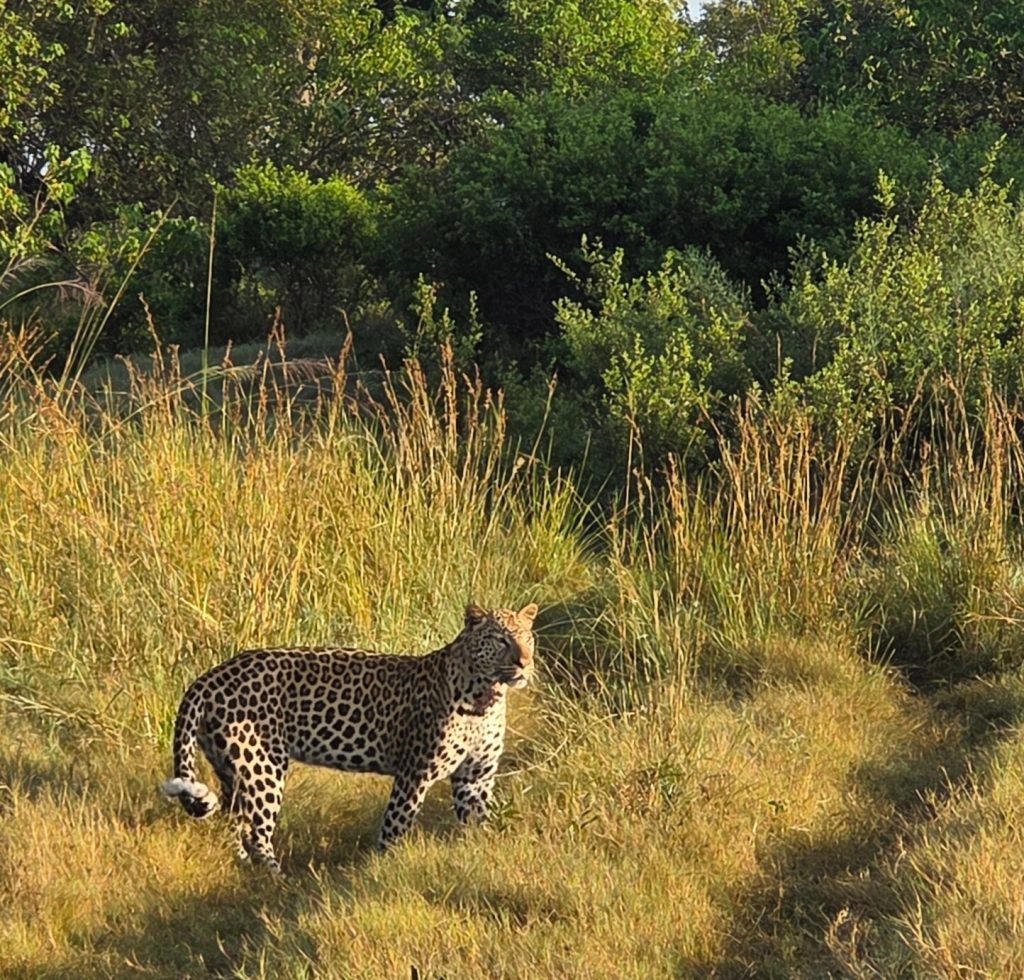
Visitors confuse the two constantly and the differences are easy to learn.
Cheetahs are built for speed, with a small head, deep chest, long legs and a lean frame. Leopards are built for strength, heavier and more muscular with a broader head.
The face is the giveaway. Cheetahs have distinctive black tear marks running from the inner eye to the mouth. Leopards do not.
Markings differ too. Cheetahs carry solid round spots. Leopards carry rosettes, meaning clusters of spots forming a rough ring around a darker centre.
Behaviour separates them decisively. Cheetahs hunt in open daylight on flat ground. Leopards hunt from cover, largely at night, and haul kills into trees. Cheetahs cannot climb well and cannot defend a kill.
Habitat follows from that, which is why the Kalahari holds cheetah and the riverine forests of Khwai hold leopard.
Frequently Asked Questions About Cheetahs in Botswana
How many cheetahs are in Botswana?
Approximately 1,700 individuals, which is around 25 to 30 percent of the world’s remaining wild cheetahs against a global population of roughly 7,000 to 7,100. Botswana and neighbouring Namibia together hold almost half the world total. The species is Africa’s most threatened large cat, with the global population having declined by around 90 percent over the past century and roughly 75 percent of its historic range lost to human encroachment.
Where is the best place to see cheetahs in Botswana?
The Central Kalahari Game Reserve, with open plains, ample springbok and lower lion density in places, particularly Deception Valley, Passarge Valley, Piper Pan and around Tau Pan. The Makgadikgadi and Nxai Pan offer the same combination of open grassland and good springbok numbers. The Kgalagadi Transfrontier Park holds a reasonable population. Chobe and the Okavango have cheetah, though dense cover and predator competition make them harder to find.
Why do most Botswana cheetahs live outside protected areas?
Because they are outcompeted inside them. Protected areas hold higher densities of larger carnivores, and lions and hyenas both kill cheetahs and steal their kills, neither of which a cheetah can prevent. Agricultural farmland ends up functioning as critical cheetah habitat, holding prey without the predator competition. Over 70 percent, and in some accounts 78 percent, of Botswana’s cheetahs live outside reserves, which puts them among livestock and into conflict with farmers.
When is the best time to see cheetahs in Botswana?
December through April, which inverts the calendar for the northern parks. The Central Kalahari, Makgadikgadi and Nxai Pan peak in the green months when rain draws back the springbok and other antelope that have been widely dispersed, and predators concentrate with the prey. Springbok lambing around December brings vulnerable prey into the open and hunting activity peaks. Cheetahs hunt in daylight, so normal morning and afternoon drive times work well.
How do you tell a cheetah from a leopard?
The face is the giveaway: cheetahs have distinctive black tear marks running from the inner eye to the mouth and leopards do not. Cheetahs carry solid round spots while leopards carry rosettes, clusters forming a rough ring around a darker centre. Build differs too, with cheetahs lean and long-legged for speed and leopards heavier and more muscular. Behaviour separates them decisively, since cheetahs hunt in open daylight and leopards hunt from cover at night.
What threatens cheetahs in Botswana?
Human-wildlife conflict above all, which is described as the greatest threat to Kalahari carnivores, cheetah and wild dog especially. Because over 70 percent live outside protected areas on farmland, they come into contact with livestock and are killed in retaliation. Cheetah Conservation Botswana works with farmers on coexistence through research, education and practical measures including livestock guarding dog programmes, on the basis that changes to land and livestock management are what will stop the decline.
Booking Your Botswana Trip
The safari companies and tour operators listed on this website put trips like this together for a living and know which camps, guides and routes actually deliver. We are an independent guide to Botswana; we do not book or sell tours ourselves.
When you are ready, arrange your safari, tour or holiday with one of the recognised operators listed here. Tell them your dates and what matters most, and a real person, not a form, will handle the itinerary, park bookings and logistics for you.