Trees and Plants of Botswana
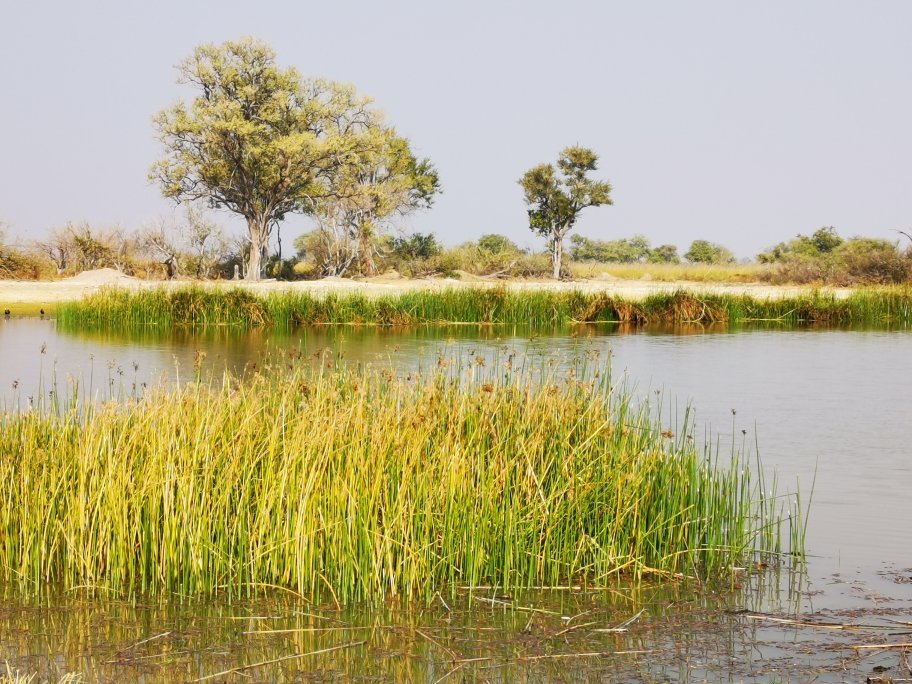
Botswana’s trees are worth knowing because they explain the country: mopane woodland covering the north, baobabs standing alone on the salt pans, jackalberries and sausage trees along the Delta channels, and leadwoods that stay upright for centuries after dying. Many carry practical uses, from devil’s claw dug for medicine in the Kalahari to mopane worms harvested for food. Learning half a dozen changes what you see from a vehicle.
Mopane, the Tree That Defines the North
If you spend time in northern Botswana you spend it among mopane, and it is worth knowing what you are looking at.
Mopane grows anywhere from a low scrub to a medium-sized tree with a rounded crown and charcoal grey bark, and it dominates the clay soils of the north to the point of forming near-monocultures known as mopane woodland.
The leaves are the giveaway, formed like butterfly wings, folding together in the heat of the day to reduce water loss. That folding produces a distinctive fluttering appearance and a resinous scent that rises in the afternoon.
They are high in nutrients at around 12 percent protein, which makes mopane important browse for elephant and other herbivores.
The tree is fire-resistant and coppices readily, which is why it recovers from the elephant damage so visible along the Chobe riverfront.
Mopane also hosts the mopane worm, the caterpillar of the mopane moth, which is harvested, squeezed, dried and roasted as food across the region.
Guides call the leadwood the ghost of the savannah. Its silver-grey skeleton stays standing for decades and sometimes centuries after the tree dies, resisting termites, rot and fire, and leopards use the bare branches as lookout posts.
The Baobab
Called mowana in Botswana, the baobab is the country’s most recognisable tree and the subject of more stories than any other.
It is the world’s largest succulent, storing water in an enormous trunk, which is what lets it survive in dry, hot country with low rainfall. Some specimens are believed to be over a thousand years old, with several Botswana trees estimated far older.
It is often called the upside-down tree, from the appearance of the bare branches in winter, and the tree of life for what it provides.
Large sweet-smelling flowers open at night and are pollinated by fruit bats. The fruit, known as monkey bread, is rich in vitamin C and calcium and is eaten by people and animals alike. Bark and leaves are used in traditional medicine.
Bees hive in the trunks, and leopards, genets and nesting birds all use them.
Botswana’s famous individuals include Chapman’s and Green’s baobabs on Ntwetwe Pan and Baines’ Baobabs in Nxai Pan National Park.
The Delta Trees
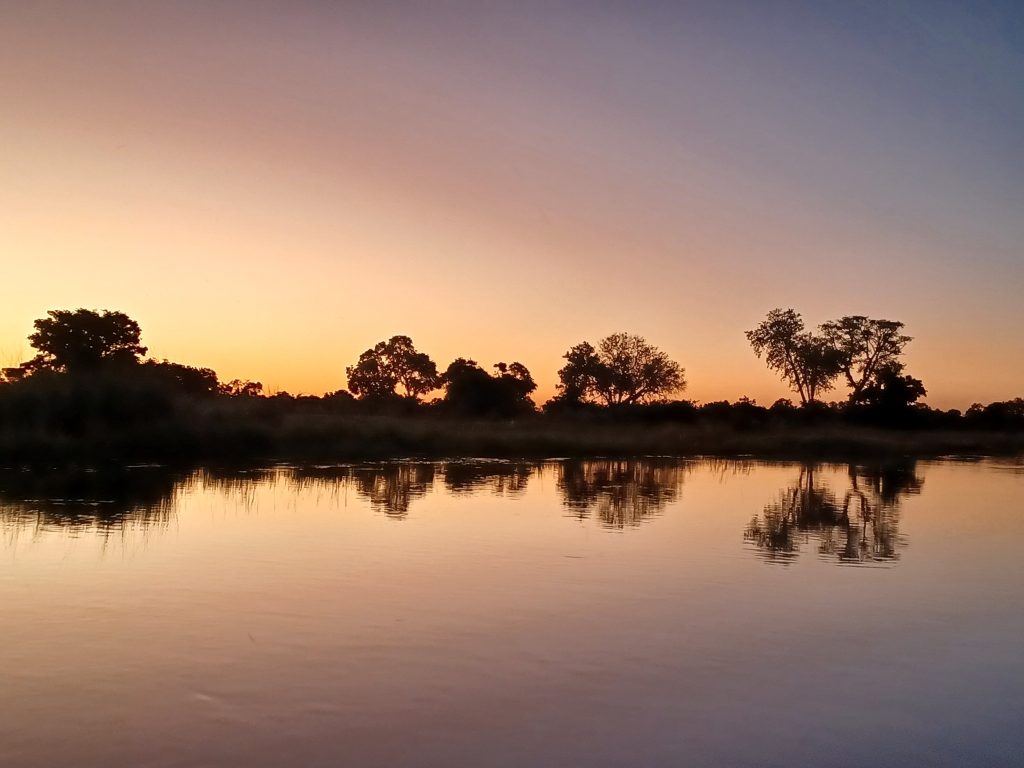
Three species define the waterways and each has a story.
Jackalberry grows supremely straight and tall with a dark green crown and bark resembling crocodile skin. That straightness made it the favoured tree for carving a mokoro, and the conservation consequence is direct: camps in northern Botswana now use fibreglass replicas to avoid felling jackalberries, which delivers the same experience without the damage. Where water is permanent they reach considerable size. Folklore holds that a person who eats jackalberry fruit and then leaves the country may become possessed by spirits.
Sausage tree is the other unmistakable one, reaching around 20 to 28 metres and hung with long sausage-like fruit that can weigh four kilograms each. Sitting under one is genuinely inadvisable. Giraffe browse the fruit directly. Kigelia cream, made from the fruit skin, is sold commercially for skin conditions, and the tree also carries traditional medicinal uses. It too was traditionally carved into mokoro.
Leadwood is among the densest hardwoods in Africa, so heavy the wood sinks in water. It resists termites, rot and fire, and the dead skeletons stand for decades. Used historically for tools and charcoal, with medicinal bark.
Papyrus and the Water Plants
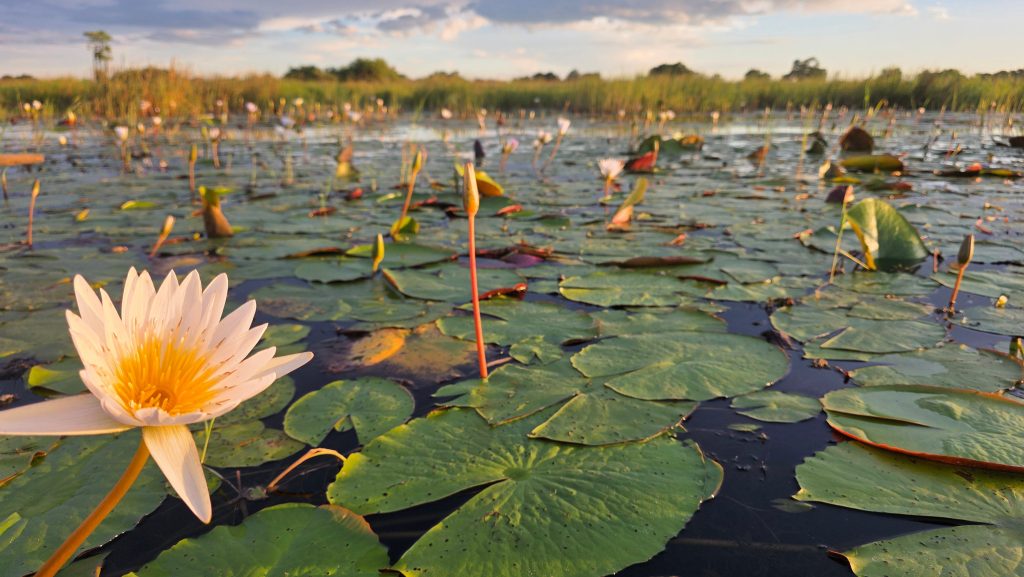
The Okavango’s structure is vegetable as much as hydrological.
Papyrus lines the permanent channels and forms the dense beds that hippos cut paths through, and those paths keep the water moving. Reeds, principally phragmites, line the main channels carrying water south through the Delta.
Water lilies cover the lagoons and shallow floodplains, and a mokoro trip through them is the classic Delta image.
Sitatunga live in the papyrus and nowhere else, which makes the plant the reason the antelope exists here.
Real fan palms stand across the islands, and their distribution is partly the work of elephants, which eat the fruit and deposit the seeds elsewhere.
The Delta holds over a thousand recorded plant species in total.
Northern woodland. Mopane dominating the clay soils, with leadwood, marula, knobthorn and camelthorn acacias, plus riverine forest of jackalberry, sausage tree and ebony along the channels.
Delta wetland. Papyrus and phragmites reed lining the channels, water lilies across the lagoons, real fan palms on the islands and enormous ebony and mangosteen trees along the waterfront.
Kalahari sandveld. Silver terminalia, Kalahari sand acacia, Kalahari apple leaf and camelthorn, with grasses dominating and baobabs on the pans. Devil’s claw and tsamma melon among the veld plants.
Useful Plants of the Kalahari
Desert plants here are working resources rather than scenery, and the San knowledge attached to them is what makes a tracking walk worth taking.
Devil’s claw, known locally as sengaparile, has tubers dug up, sliced, dried and crushed for use against arthritis, stomach disorders and skin problems. It is harvested commercially and exported.
Tsamma melon, or kgengwe, is a water source in country with none, eaten raw or boiled with the seeds roasted. Watermelon is thought to have originated in this region.
Morama, the gemsbok bean, has seeds that are roasted, made into a butter or ground to powder for a drink, and yields oil.
Mosukujane, the lemon bush, is used for colds, coughs, asthma, fever and headaches. Wild tea, lengama, has leaves dried and crushed for infusion.
Thepe, a pigweed, is cooked like spinach, and delele is the wild okra that appears in Kalanga cooking.
Reading the Trees on Safari

A few practical habits turn vegetation from background into information.
Habitat tells you what to expect. Mopane woodland holds different animals from riverine forest, and a guide moving from one to the other is changing the odds deliberately.
Leadwood skeletons are leopard furniture, so scan them.
Marula fruit brings elephants, which are particularly fond of it, so a marula grove in fruit is worth checking.
Sausage trees drop fruit that draws browsers, and the flowers feed nectar-eaters.
Termite mounds support their own vegetation, standing slightly higher and better drained, which is why tsessebe stand on them and why islands in the Delta frequently begin as termite mounds.
Ask your guide about trees. Most enjoy it and it opens up an entire layer of a drive that most guests never notice.
Grasses repay the same attention, although almost nobody gives them any. The Kalahari’s waist-high golden grasses are what draw the zebra migration south each year, and the difference between sweet grazing and sour grazing decides where the herds go. A guide who can tell you which grass you are looking at is telling you why the animals are there, which is a more useful answer than the animals themselves.
The islands of the Okavango largely begin as termite mounds. A mound rises just above flood level, catches seeds, grows trees, traps more sediment and eventually becomes an island with a fig or a palm at its centre. Almost every island in the Delta started that way.
Frequently Asked Questions About Botswana’s Trees and Plants
What is the mopane tree and why does it matter?
Mopane dominates the clay soils of northern Botswana, growing anywhere from low scrub to a medium-sized tree with charcoal grey bark, and forming near-monocultures known as mopane woodland. Its butterfly-like leaves fold together in the heat to reduce water loss. Leaves run around 12 percent protein, making it important browse for elephant. It is fire-resistant and coppices readily, and it hosts the mopane worm, harvested as food across the region.
How old are Botswana’s baobabs?
Some are believed to be over a thousand years old, with several famous Botswana specimens estimated considerably older, and one landmark tree on the pans put at three to four thousand years. Baobabs grow extremely slowly, with stem circumference increasing by roughly a millimetre a year, which is why Baines’ Baobabs look much as they did in a Victorian painting. The baobab is the world’s largest succulent, storing water in its trunk.
What tree is a mokoro made from?
Traditionally jackalberry, which grows supremely straight and tall and was the favoured species, and sometimes sausage tree. Because felling large jackalberries damages the ecosystem, camps in northern Botswana now use fibreglass replicas, which deliver the same experience without the loss. If a camp is still using hardwood mokoro, that is a reasonable thing to ask about, since the fibreglass switch is the responsible practice.
Why do dead leadwood trees stay standing?
Because leadwood is among the densest and heaviest hardwoods in Africa, dense enough that the wood sinks in water, and it resists termites, rot and fire. The silver-grey skeletons remain upright for decades and sometimes centuries after the tree dies, which earned it the name ghost of the savannah. Leopards use the bare branches as lookout posts and resting places, so they are worth scanning on a drive.
What is devil’s claw used for?
Its tubers are dug up, sliced, dried and crushed, and used traditionally against arthritis, stomach disorders and skin problems. Known locally as sengaparile and found across the Kalahari, it is now harvested commercially and exported, which raises its own sustainability questions. It sits among a wider group of Kalahari veld plants including tsamma melon as a water source, morama or gemsbok bean, and lemon bush for colds and fever.
Why are there islands in the Okavango Delta?
Most begin as termite mounds. A mound rises just above flood level, catches windblown and waterborne seeds, grows vegetation, traps further sediment and gradually builds into an island, often with a fig or a palm at its centre. Real fan palms across the islands owe much of their distribution to elephants, which eat the fruit and deposit the seeds elsewhere. The Delta holds over a thousand recorded plant species.
Booking Your Botswana Trip
The safari companies and tour operators listed on this website put trips like this together for a living and know which camps, guides and routes actually deliver. We are an independent guide to Botswana; we do not book or sell tours ourselves.
When you are ready, arrange your safari, tour or holiday with one of the recognised operators listed here. Tell them your dates and what matters most, and a real person, not a form, will handle the itinerary, park bookings and logistics for you.