Okavango Delta Guide

The Okavango Delta is an inland river delta in northern Botswana that never reaches the sea, spreading across the flat Kalahari sands until it evaporates and soaks away. It swells to somewhere between 15,000 and 22,000 square kilometres at peak flood, which arrives in the middle of the dry season because the water fell as rain in Angola four months earlier. UNESCO listed it as its thousandth World Heritage Site.
How the Okavango Delta Works
Almost everything unusual about the Delta follows from its hydrology, and it is worth grasping properly because it determines when you should visit.
Rain falls over the Angolan highlands during the southern summer. That water enters the Okavango River, flows south through Namibia’s Caprivi and crosses into Botswana through a narrow corridor known as the Panhandle around April.
From there it fans out across a tectonic trough in the Kalahari, slowed by the almost complete lack of gradient, and takes until roughly July to reach the outer Delta. By then local rainfall in Botswana has stopped entirely.
The water never finds an ocean. Some drains south into the Boteti River toward the Makgadikgadi, a little more escapes down the Selinda Spillway, and the overwhelming majority simply evaporates or seeps into the sand.
The result is a wetland at its fullest in the driest months, surrounded by desert, which is a combination that occurs almost nowhere else.
The Delta floods in the dry season and dries in the wet one. Rain that fell in Angola in January reaches the outer channels around July, by which time Botswana itself has not seen rain for months.
The Regions of the Okavango Delta
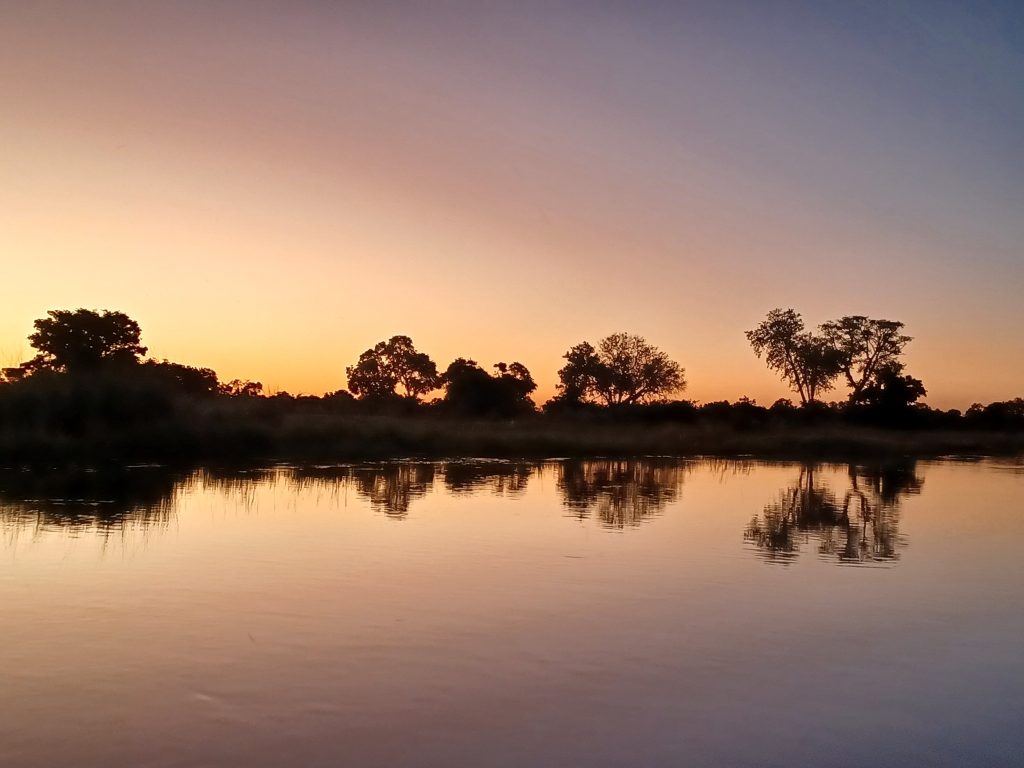
The Delta is not one habitat and the differences between its parts matter more than most first visitors expect.
The Panhandle in the northwest is where the river enters Botswana, still confined between parallel faults, deep and permanent and known for fishing and birding rather than big game.
The permanent inner Delta holds water year round in papyrus-lined channels and lagoons. This is mokoro and motorboat country, with red lechwe on the floodplains and sitatunga in the reeds.
The seasonal floodplains flood and drain annually, producing the richest grazing and the strongest general game viewing.
The drier eastern margins, including Moremi Game Reserve and the Khwai area, are largely land-based, and this is where the big cat viewing concentrates.
Chief’s Island, the largest island in the system at the heart of Moremi, holds the highest concentrations of large mammals.
Around all of it sit private and community concessions, which is where most camps actually are.
Wildlife of the Okavango Delta

The Delta supports an unusual combination of water-adapted and dryland species because both habitats exist within a few kilometres of each other.
Predators are the headline. Lion prides are strong and some have adapted to hunting through water. Leopard hold along the treelines. The Delta and its surrounds carry one of Africa’s more secure populations of African wild dog, and cheetah occur on the more open ground.
Elephant move through in large numbers, swimming between islands. Buffalo herds use the floodplains. Hippo and crocodile are permanent in the channels and lagoons.
The specialists are what set the place apart. Red lechwe are built for running through shallow water. Sitatunga, the swamp-dwelling antelope with splayed hooves, is genuinely difficult to see anywhere else.
Birdlife runs past 400 species with wattled crane, Pel’s fishing owl, African skimmer and slaty egret among the rarities. Over a thousand plant species have been recorded.
Both black and white rhino have been reintroduced to Moremi, making the wider area a Big Five destination again.
People of the Okavango Delta
The Delta is not empty country and has not been for a very long time.
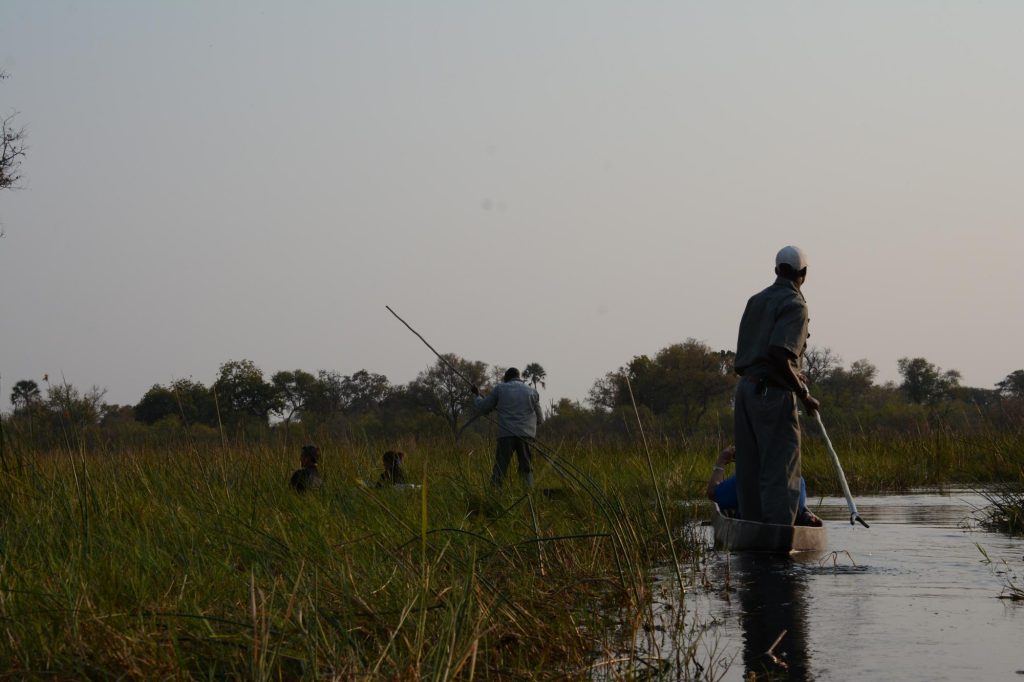
Several communities live in and around it. The BaYei are closely associated with the waterways and are credited with bringing the mokoro into the Delta. The HaMbukushu settled the Panhandle region. The BaSarwa, also known as San, have the longest presence of all. The BaTawana, whose leadership proclaimed Moremi Game Reserve, are the dominant group in Ngamiland. If you would rather not build it yourself, a 4 day Okavango Delta safari covers this ground on a set departure.
That history is why so much of the Delta’s protected land sits under community management rather than state control. Moremi was the first reserve in Africa established by an African community on their own land, and the Khwai concession beside it is owned and run by Khwai Village through a community trust. For a night-by-night plan of the water country, see our Okavango Delta itinerary.
Polers on a mokoro trip are frequently from nearby villages rather than camp staff, which is worth knowing at tipping time.
Cultural village visits are offered by several camps and community trusts and are the most direct way to meet that side of the Delta.
Water areas. Permanent inner Delta and the Panhandle. Mokoro, motorboat, island walks, fishing. Lechwe, sitatunga, hippo, crocodile and exceptional birding. Fewer big cats.
Land areas. Moremi, Khwai and the drier eastern margins. Game drives across floodplain and mopane. Lion, leopard, wild dog and the strongest predator viewing in the country.
Mixed camps. Properties offering both land and water year round, which exist in several concessions and are the answer for a short Delta stay where you do not want to move camps.
Getting to and Around the Okavango Delta
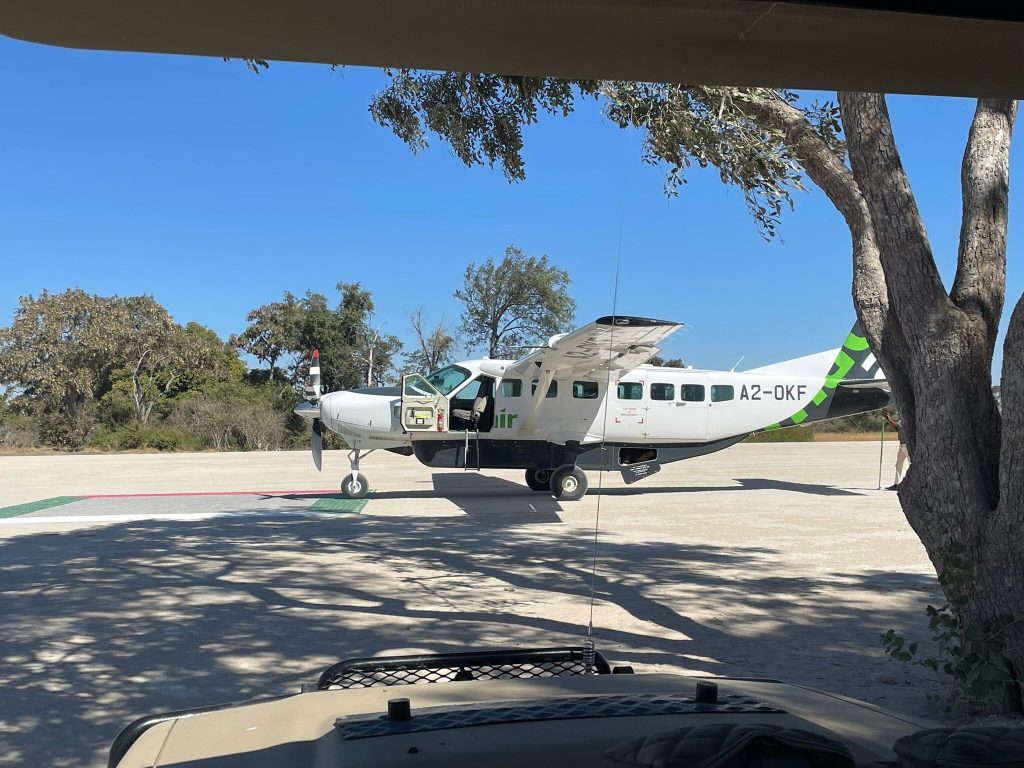
Access shapes the cost of a Delta trip more than anything except camp choice.
Maun is the gateway. Almost all remote camps are reached by light aircraft from Maun airport on flights of fifteen to forty-five minutes, and the flight over the channels at low altitude is genuinely one of the better parts of the trip.
Charter luggage is capped at roughly 20kg per person in a soft bag including camera gear, which catches people out.
The eastern margins are reachable by road. Moremi’s South Gate and North Gate take 4×4 traffic, and the Khwai community area is a few hours from Maun through thick sand and water crossings. That is the route mobile safaris and self-drivers use.
The inner Delta cannot be driven to at all, since parts are surrounded by water with no road through.
Mokoro trails from poling stations near Maun are the budget way in, with dome tent camping on remote islands.
Conservation and Threats to the Okavango
The Delta’s protection is unusually good and its vulnerabilities sit largely outside Botswana’s borders.
Botswana protects the system through Moremi, the concession framework and the UNESCO listing, and the country’s low-volume tourism policy caps bed numbers deliberately to limit pressure.
The risks are upstream. The Okavango River rises in Angola and passes through Namibia before reaching Botswana, so water abstraction, damming or catchment change in either country would affect the flood. A permanent commission exists between the three states to manage the basin jointly.
Oil and gas exploration licences in the wider Okavango catchment have drawn international concern in recent years.
Flood volume also varies naturally year to year, and low-flood years shorten the mokoro season and reduce how far water reaches into the outer Delta.
Ask your operator what this year’s flood is doing rather than relying on averages. They know by around March what June will look like, and in a low year the difference between a permanent water camp and a seasonal one becomes the whole trip.
Best Time to Visit the Okavango Delta
The Delta rewards matching your month to what you want, since water and wildlife peak at slightly different times.
June through September is peak flood. Mokoro and boat activities are at their best, channels reach furthest, and camps on seasonal water are all operating. Mornings in June and July are cold, around 6°C to 7°C.
September and October give the sharpest predator viewing, as surface water elsewhere disappears and game concentrates, at the cost of considerable heat.
November through March is green season. The outer Delta is at its lowest before the new flood arrives, many seasonal camps run drives only, birding is at its best with migrants in, antelope calve and rates fall by up to 40 percent.
April and May are the shoulder, with the flood building, thinning bush and rates below peak.
Frequently Asked Questions About the Okavango Delta
How big is the Okavango Delta?
It varies with the flood, swelling to somewhere between 15,000 and 22,000 square kilometres at peak. That variation is the nature of the system rather than uncertainty in the measurement, since the seasonal floodplains flood and drain each year while the inner Delta holds water permanently. UNESCO listed the Okavango as its thousandth World Heritage Site, recognising both the scale of the wetland and the fact that its flood cycle runs opposite to the local rainfall.
Why does the Okavango Delta flood in the dry season?
Because the water falls as rain somewhere else. Summer rain over the Angolan highlands enters the Okavango River, flows south through Namibia and crosses into Botswana through the Panhandle around April, then spreads slowly across an almost flat tectonic trough, reaching the outer Delta around July. By that point Botswana itself has had no rain for months. The water never reaches the sea, evaporating or soaking into the Kalahari sands.
What animals live in the Okavango Delta?
Lion, leopard, cheetah and one of Africa’s more secure African wild dog populations, alongside elephant, buffalo, hippo, crocodile, giraffe and zebra. The water specialists are what set it apart: red lechwe built for running through shallow water and sitatunga, the swamp antelope, which is difficult to see anywhere else. Both black and white rhino have been reintroduced to Moremi. Birdlife runs past 400 species with over a thousand plant species recorded.
How do you get to the Okavango Delta?
Maun is the gateway, with almost all remote camps reached by light aircraft on flights of fifteen to forty-five minutes. Charter luggage is limited to roughly 20kg per person in a soft bag including camera gear. The eastern margins are reachable by 4×4, with Moremi’s gates and the Khwai area a few hours from Maun through thick sand and water crossings. The inner Delta cannot be driven to, as parts are surrounded by water with no road through.
What is a mokoro?
A traditional dugout canoe, poled from standing at the stern, which moves through papyrus channels at walking pace with almost no sound. The BaYei are credited with bringing the mokoro to the Delta. Modern versions are frequently fibreglass rather than carved from a tree, for conservation reasons. Mokoro trips depend on channel water levels, so they run year round at permanent water camps and seasonally elsewhere.
When is the best time to visit the Okavango Delta?
June through September for water activities, when the flood peaks and mokoro and boat trips reach furthest. September and October for predators, when surface water elsewhere has gone and game concentrates, though the heat is considerable. November through March is green season, with the outer Delta at its lowest, excellent birding, calving antelope and rates falling by up to 40 percent. April and May are a good shoulder compromise.
Booking Your Botswana Trip
The safari companies and tour operators listed on this website put trips like this together for a living and know which camps, guides and routes actually deliver. We are an independent guide to Botswana; we do not book or sell tours ourselves.
When you are ready, arrange your safari, tour or holiday with one of the recognised operators listed here. Tell them your dates and what matters most, and a real person, not a form, will handle the itinerary, park bookings and logistics for you.