Binoculars for Safari

The standard binocular for a Botswana safari is 8×42, offering a wide field of view, a steady image in a moving vehicle and strong low-light performance at dawn and dusk when wildlife is most active. 10×42 suits open country like the Kalahari and the pans, trading brightness and stability for extra detail. Botswana is a southern African safari country where most camps do not supply binoculars, making your own pair the single item travellers most often regret leaving behind.
Why You Need Your Own Binoculars on Safari
Some lodges provide binoculars. Most do not guarantee it, and a shared pair passed around a vehicle means somebody is always missing the thing everyone else is looking at.
What binoculars actually change is what you see rather than how far you see. A leopard in a sausage tree at eighty metres is a shape to the naked eye and an animal through glass, with the spots resolving, the tail hanging, the ear turning. Birds go from brown to identifiable. The lechwe on a floodplain becomes a herd with lambs in it.
Your guide will be pointing at things you cannot find. Binoculars are how you catch up.
They also weigh little against a 20kg charter allowance, which is a rare thing on a safari packing list.
What the Binocular Numbers Mean for Safari Viewing
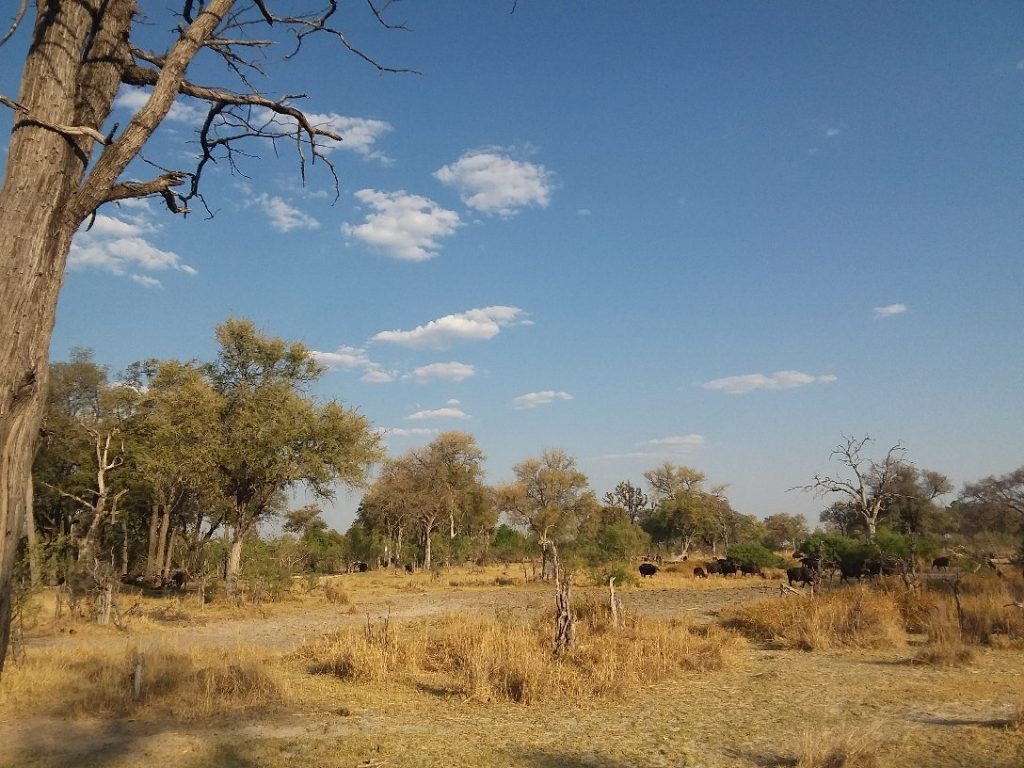
The two numbers on every pair tell you most of what matters. In 8×42, the eight is magnification, meaning the image appears eight times closer. The 42 is the diameter of the front lens in millimetres, which governs how much light gets in.
Divide the second by the first and you get the exit pupil, the width of the beam of light reaching your eye. An 8×42 produces 5.25mm. A 10×42 produces 4.2mm. A 10×32 produces just 3.2mm.
Why that matters: in bright daylight your pupil contracts to around 2 or 3mm, so any of these look equally bright. At dawn and dusk your pupil dilates to somewhere between 5 and 7mm, and then the wider beam of the 8×42 fills your eye where the narrower one does not. Since dawn and dusk are exactly when a safari happens, exit pupil is not a technical footnote here.
Field of view is the third number worth checking, usually given in feet at a thousand yards. An 8×42 typically offers somewhere around 350 to 430 feet, a 10×42 around 300 to 340.
Choosing Between 8×42 and 10×42 for a Botswana Safari
This is the only real decision, and both answers are defensible.
8×42 gives a wider field of view, which makes finding a moving animal far easier, particularly when a guide is describing where to look. It gives a steadier image, because every hand tremor and every vehicle vibration is magnified eight times rather than ten. It gives the larger exit pupil for dawn and dusk. It is more forgiving to line your eyes up with, which matters for spectacle wearers, and it usually has longer eye relief. It is also often slightly cheaper, since it is the most popular configuration and manufacturers produce more of them.
10×42 gives more detail on distant subjects, which matters in genuinely open country. The Central Kalahari, the Makgadikgadi pans and Nxai Pan all put real distance between you and the wildlife, and the extra reach earns itself there. It also helps for identifying distant raptors.
The trade is stability. At ten times magnification, the shake in your hands and the vibration of a vehicle with its engine running become noticeable, and holding a steady image for a long look is harder.
For a first Botswana safari covering the Delta, Moremi and Chobe, 8×42 is the safer choice. If the Kalahari and the pans dominate your itinerary and you have steady hands, 10×42 makes a good case.
8×42. Wider field of view around 350 to 430 feet, exit pupil 5.25mm, steadier image, longer eye relief, more forgiving eye placement. Best for the Okavango, Moremi, Chobe, birding and anyone new to binoculars.
10×42. More detail at distance, exit pupil 4.2mm, field of view around 300 to 340 feet. Best for the Central Kalahari, Makgadikgadi and Nxai Pan, and for identifying distant raptors. Needs steadier hands.
Compact 8×32 or 10×32. Lighter and smaller, exit pupil 4mm and 3.2mm respectively. Useful as a second pair or for children. The smaller exit pupil shows at dawn and dusk, which is when you most want them.
Compact Binoculars and Weight on a Fly-in Safari
Compacts are tempting against a tight luggage allowance, and the compromise is real.
An 8×32 gives a 4mm exit pupil, noticeably less than the 5.25mm of an 8×42 but still workable. A 10×32 drops to 3.2mm, and that shows clearly in the first and last hour of light, which is when the cats move.
A full-size 42mm pair typically weighs somewhere around 650 to 800 grams, which against a roughly 20kg charter limit is not the item to cut. Photographers carrying a 200-600mm lens are giving up far more weight elsewhere.
Where compacts genuinely earn their place is as a second pair, so that two people in a couple each have glass, or for a child who will struggle to hold a heavy pair steady.
Optical Quality and What to Look For
Beyond the numbers, a few features matter on safari in particular.
Waterproofing and nitrogen or argon purging prevent internal fogging, which matters on cold winter mornings when you step from a warm vehicle blanket into 6°C air, and on mokoro trips where water is inches away.
Eye relief matters if you wear glasses. Look for something around 15mm or more, with twist-up eyecups you can retract. Insufficient eye relief means you cannot see the full field with spectacles on, which is a daily irritation rather than an occasional one.
Close focus is worth checking for anyone interested in birds and insects around camp, since some binoculars will not focus closer than several metres.
Coatings and glass quality separate mid-range from cheap. The visible difference is contrast and colour in poor light rather than raw magnification, which is precisely the light you will be using them in.
Set the dioptre adjustment properly before your first drive rather than fighting a soft image all week. Cover the right lens, focus on something distant with the centre wheel using your left eye only, then cover the left and adjust the dioptre ring for the right. Note the setting so you can restore it.
Using Binoculars Well on a Game Drive
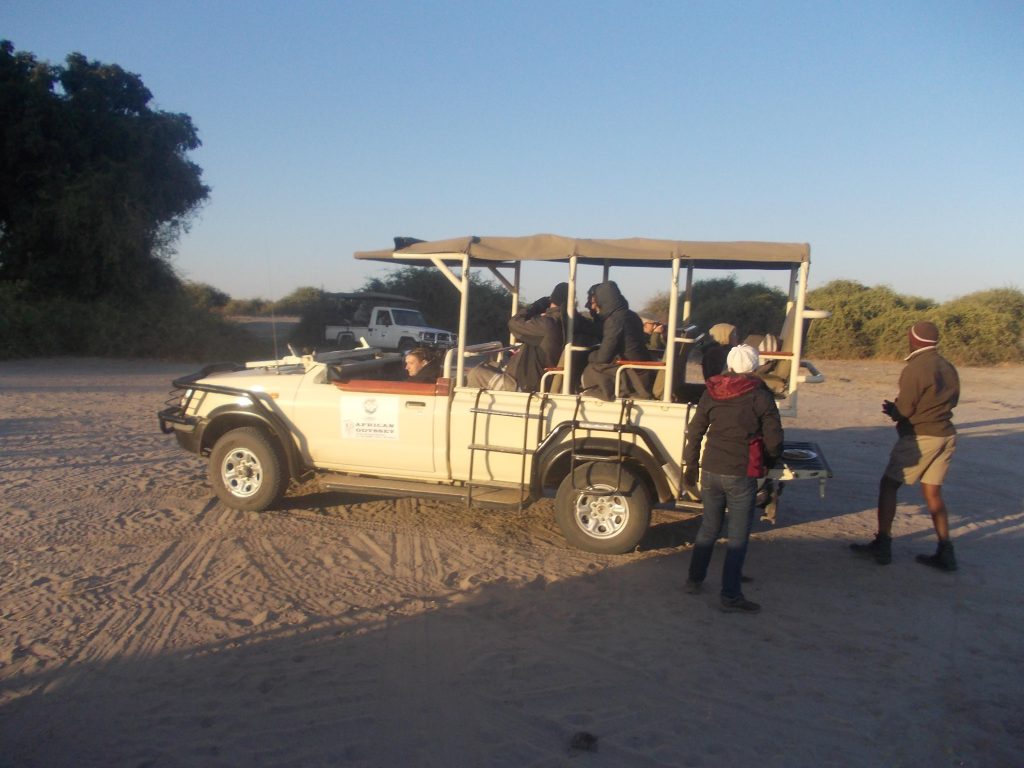
A few habits make a large difference and almost nobody explains them.
Find the animal with your eyes first, keep your eyes locked on it, then bring the binoculars up to your face without looking away. Searching for a subject through the glass is how people spend a sighting scanning empty bush.
Rest your elbows on your knees or the seat back rather than holding them out unsupported, which steadies the image considerably at either magnification.
Ask the guide to switch the engine off if you want a long look at something distant. Idling vibration travels through the vehicle and into your hands, and most guides will kill the engine without being asked once they know you are watching properly.
Wear the strap. A dropped pair on a metal vehicle floor over a corrugated track is the end of them, and a chest-style strap spreads the weight better than a neck strap over a long morning.
Frequently Asked Questions About Safari Binoculars
What magnification binoculars are best for safari?
8×42 is the standard recommendation and the safest choice for a first Botswana safari. It gives a wide field of view for finding animals quickly, a steady image in a moving vehicle, and a 5.25mm exit pupil that performs well at dawn and dusk when wildlife is most active. 10×42 offers more detail at distance and suits the open country of the Central Kalahari and the salt pans, at the cost of a narrower view, a smaller 4.2mm exit pupil and a shakier image.
Do safari lodges provide binoculars?
Some do and many do not, and provision is never guaranteed even at expensive camps. Where a camp does supply them there is often one pair per vehicle rather than one per guest, which means sharing and missing sightings while you wait your turn. Bringing your own is the single most commonly recommended addition to a Botswana packing list, and a full-size pair weighs only around 650 to 800 grams against a roughly 20kg charter allowance.
Are compact binoculars good enough for safari?
Workable rather than ideal. An 8×32 gives a 4mm exit pupil, less than the 5.25mm of an 8×42 but usable. A 10×32 falls to 3.2mm, which shows noticeably in the first and last hour of daylight, exactly when predators are active. Compacts make good sense as a second pair so both people in a couple have glass, or for a child who cannot hold a full-size pair steady, rather than as a primary choice.
How much should I spend on safari binoculars?
Solid mid-range 8×42 models with good glass and coatings are available from roughly 300 to 500 US dollars, and reviewers regularly note that models around 330 dollars now compete optically with pairs costing 500 or more. Premium 10×42 options with exceptional eye relief and edge sharpness sit closer to 700. Very cheap binoculars are a false economy on safari, since what you lose is contrast and colour in poor light, which is the light you will actually be using.
Can I use binoculars if I wear glasses?
Yes, provided you check eye relief before buying. Look for around 15mm or more, with twist-up or fold-down eyecups you can retract to sit against your spectacle lenses. Insufficient eye relief means you cannot see the full field of view with glasses on, which becomes a daily frustration. The 8×42 configuration is usually more forgiving on eye placement than 10×42, and several models offer eye relief above 19mm aimed at spectacle wearers.
Do I need waterproof binoculars for Botswana?
Worth having, for two reasons more than rain. Mokoro and boat trips in the Okavango put you inches from water with spray a constant possibility. And nitrogen or argon purging prevents internal fogging when you move between a cold 6°C winter morning and a warm vehicle, which is a daily transition on a dry season safari. Sealed and purged models also keep dust out, and Botswana from August onward is dust.
Booking Your Botswana Trip
The safari companies and tour operators listed on this website put trips like this together for a living and know which camps, guides and routes actually deliver. We are an independent guide to Botswana; we do not book or sell tours ourselves.
When you are ready, arrange your safari, tour or holiday with one of the recognised operators listed here. Tell them your dates and what matters most, and a real person, not a form, will handle the itinerary, park bookings and logistics for you.