Savuti

Savuti is the western section of Chobe National Park, built around a channel that has flowed and dried repeatedly over the past century and a half for reasons nobody has fully explained. It is where lions were first recorded killing adult elephants, where the rivalry between lions and hyenas was first documented, and where dead trees still stand as evidence of the last time the water came back. The name is thought to derive from a Bayei word meaning unclear, which suits the place exactly.
The Savuti Channel and Its Unpredictable Water
Everything distinctive about Savuti follows from one river that cannot decide whether to exist.
The channel runs roughly 100 kilometres from the Chobe and Linyanti water system, through a gap in a sand ridge, into the Mababe Depression, where it spreads into the Savuti Marsh. Over that whole distance it falls only around eighteen metres, which is part of why its behaviour is so finely balanced.
The pattern, as far as records go, is this. It flowed in Livingstone’s time. It was dry by the eighteen eighties and stayed dry for roughly seventy years. It flooded again in the late nineteen fifties, ran for around a quarter century, then dried once more in the early eighties. It began flowing again in the late two thousands, reached the marsh about two years later, and has since dried back.
Geologists attribute the cycle to small tectonic movements along fault lines near the channel’s source, which alter its ability to flow. Nobody can predict when it will run again.
Check the current state before booking, because it changes what Savuti is.
The dead trees standing across the Savuti Marsh are the record of the last time the water returned. They grew in a dry riverbed over decades, then drowned when the channel came back.
The Lions of Savuti and the Elephant Hunts
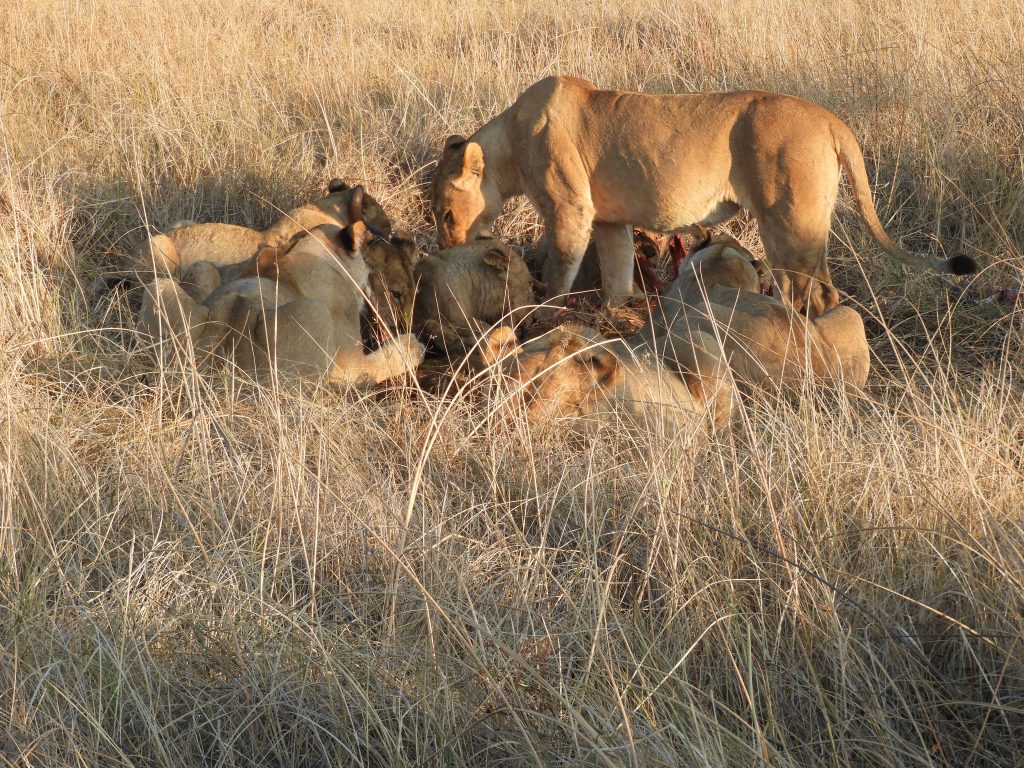
Savuti’s reputation among safari travellers rests on predator behaviour recorded almost nowhere else.
When the channel dried in the early eighties the marsh dried with it, and artificial waterholes became the lifeline for the animals that remained. In that environment a lion pride numbering over thirty individuals developed a specialisation in hunting adult elephant, typically targeting adolescents at the edge of breeding herds and relying on numbers and persistence rather than any single decisive move.
There is no settled explanation for how the behaviour arose. Theories range from ancient predatory memory to the simple consequence of humans concentrating elephants at artificial water in dry country.
When the channel returned, the ecosystem changed and the great pride broke up. Elephant hunting still occurs but far less regularly than in the dry years.
Savuti is also where the antagonism between lions and spotted hyenas was first properly documented, and hyena numbers here remain unusually high.
The Geography of Savuti
Five features shape the area and they are interlinked in a way that becomes obvious once you see them.
The Mababe Depression is the floor of an ancient lake, flat and enormous. The Magwikhwe Sand Ridge is its old shoreline, a wall of sand marking where the water once ended. The Savuti Marsh sits where the channel spills into the depression. The Savuti Channel itself cuts through the ridge. And the rocky outcrops, chiefly the Gubatsa Hills, are dolomite hills rising abruptly from the flat country.
The Gubatsa Hills hold San rock paintings, and several camps run visits to them. During the driest years crocodiles were reported taking refuge in the hills, which gives some sense of what this country does to animals.
Savuti sits between the Chobe riverfront to the northeast and the Okavango to the west, with the Chobe Forest Reserve and the thick sand of the Ghoha Hills on the way in from the north.
The area is commonly given as around 5,000 square kilometres, though figures vary depending on where the boundaries are drawn.
Wildlife and the Savuti Zebra Migration
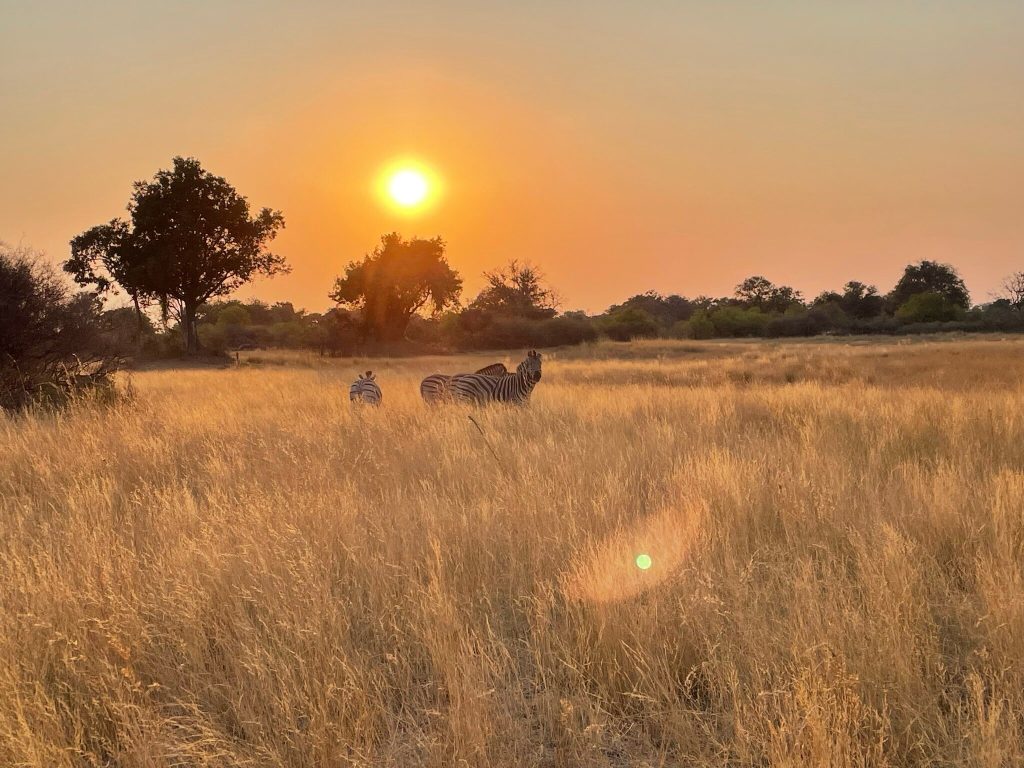
Savuti holds one of the great animal concentrations in southern Africa, and it varies sharply by season.
Elephant are present year round, sustained by artificially maintained waterholes, and Savuti is particularly known for old bulls. Buffalo herds are large, and lion, spotted hyena, leopard and cheetah all work them. African wild dog occur here in good numbers, and Savuti is rated among the better places in Africa to find them.
Tsessebe, roan, sable, kudu, impala and warthog are all present, with birdlife strong across the marsh and grassland.
The zebra movement is the seasonal event. From around November into December thousands of zebra move south from the Linyanti through Savuti to the grasslands of the Mababe Depression, following fresh grazing brought by the first rains. They return north as the dry season sets in.
When the marsh is wet the country supports far larger buffalo and elephant herds. When it is dry the game concentrates on the pumped waterholes, which makes finding it simpler and the interactions more intense.
Dry cycle Savuti. Marsh and channel dry, game concentrated at artificial waterholes, dust and heat, intense predator activity. The conditions that produced the elephant-hunting lions.
Wet cycle Savuti. Channel flowing into the marsh, green and fertile, far larger buffalo and elephant herds, more dispersed game. A completely different place to visit.
Green season, November to March. Zebra move south from the Linyanti to the Mababe Depression, calving follows, predators concentrate on the herds. Dramatic skies over the marsh.
Visiting Savuti

Savuti is technically part of Chobe National Park but functions as an entirely separate destination, and the game viewing and vegetation have little in common with the Chobe riverfront.
Access is by light aircraft to the Savuti airstrip, roughly twenty to forty minutes from Kasane or Maun, or by road through deep sand. The drive from the Chobe riverfront runs through the thick sand of the Chobe Forest Reserve past the Ghoha Hills, and it is a serious undertaking rather than a transfer.
Being inside the national park, Savuti prohibits off-road driving, night drives and guided walking, with gates closing at set hours. Camps on the private concessions further west in the Linyanti offer all three.
Park entry runs at 120 Pula per person per day for non-residents, or 70 Pula through a licensed Botswana operator, with camping charged separately.
One public campsite serves the area, alongside several lodges ranging from classic to tented luxury and a mobile camp that moves between sites near the channel.
Is Savuti Crowded?
Savuti carries a reputation in some circles for being busy, and it is worth putting that in proportion.
The impression comes largely from one place. Sunset Pan sits close to the public campsite and functions as the start and end point for most game drives, which means vehicles pass through it at the same two times each day.
Away from that pinch point the area is large and vehicle numbers thin out quickly. Staying at one of the lodges rather than the campsite, and heading out on tracks away from the campsite loop, removes most of the problem.
Compared with the Chobe riverfront near Kasane, which absorbs day visitors from Victoria Falls, Savuti is considerably quieter.
It is not the Linyanti concessions, where vehicle numbers are capped by agreement, and anyone whose priority is solitude should look there instead.
Ask your operator what the channel is doing before you book. A flowing Savuti and a dry Savuti are genuinely different destinations, and photographs on a camp website may show conditions from a cycle that ended years ago.
Best Time to Visit Savuti
Savuti works across the year and the character changes completely between seasons.
The dry months from May to October concentrate game on the waterholes, which makes predator viewing straightforward and intense. Elephant numbers along the pumped water build through the season. Mornings are very cold, close to freezing in June and July, followed by hot days, and by October the heat is considerable.
November through March brings the rains, greens the marsh, and delivers the zebra movement south to the Mababe Depression along with calving and the predators that follow.
Photographers often prefer the dry months for the dust and the concentration, and the green months for the skies and the newborn game.
Whatever the season, the elephant are there.
Frequently Asked Questions About Savuti
Where is Savuti?
In the western section of Chobe National Park in northern Botswana, between the Chobe riverfront to the northeast and the Okavango Delta to the west. It is built around the Savuti Channel, which runs roughly 100 kilometres from the Chobe and Linyanti system through a gap in the Magwikhwe Sand Ridge into the Mababe Depression. Access is by light aircraft to the Savuti airstrip or by road through deep sand from Kasane or Maun.
Is the Savuti Channel flowing?
It varies, and the answer changes over years rather than seasons. The channel flowed in Livingstone’s time, dried by the eighteen eighties for around seventy years, flooded again in the late nineteen fifties, dried in the early eighties, began flowing again in the late two thousands and reached the marsh about two years later, then dried back. Geologists attribute the cycle to tectonic movement near the source. Check the current state with your operator before booking.
Do lions really hunt elephants at Savuti?
Yes, though less often than during the dry years. When the channel dried in the early eighties a pride numbering over thirty individuals developed a specialisation in hunting adult elephant, usually targeting adolescents at the edge of breeding herds using numbers and persistence. There is no settled explanation for how the behaviour arose. When the channel returned the pride broke up, and while some prides still hunt elephant the behaviour is now occasional rather than routine.
What are the Gubatsa Hills?
Dolomite rock outcrops rising abruptly from the otherwise flat Savuti country, and one of the area’s five defining geological features alongside the Mababe Depression, the Magwikhwe Sand Ridge, the marsh and the channel. They hold San rock paintings, and several camps run visits to the sites. During the driest years crocodiles were reported sheltering in the hills, which gives a sense of how extreme conditions became.
Can you do night drives in Savuti?
No. Savuti sits inside Chobe National Park, which prohibits night drives along with off-road driving and guided walking, and gates close at set hours. Camps on the private concessions further west in the Linyanti and Selinda areas permit all three, which is the main reason experienced travellers pay concession rates. If night drives matter to you, that decides where you stay rather than whether you visit Savuti.
Is Savuti too busy for a good safari?
The reputation comes mostly from one location. Sunset Pan sits near the public campsite and serves as the start and end point for most game drives, so vehicles pass through at the same two times daily. Away from that the area is large and traffic thins quickly. Savuti is considerably quieter than the Chobe riverfront near Kasane, which takes day visitors from Victoria Falls, though busier than the capped-vehicle Linyanti concessions.
Booking Your Botswana Trip
The safari companies and tour operators listed on this website put trips like this together for a living and know which camps, guides and routes actually deliver. We are an independent guide to Botswana; we do not book or sell tours ourselves.
When you are ready, arrange your safari, tour or holiday with one of the recognised operators listed here. Tell them your dates and what matters most, and a real person, not a form, will handle the itinerary, park bookings and logistics for you.